
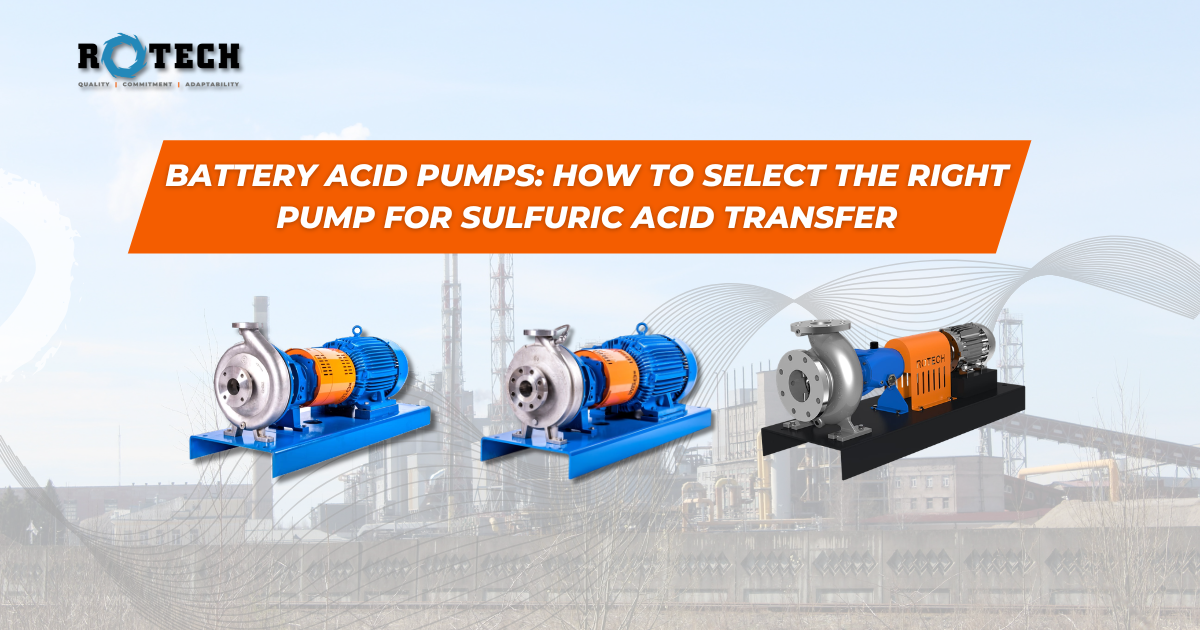
Sulfuric acid is one of the most widely used industrial chemicals in the world – and one of the most unforgiving when it comes to pump selection. Use the wrong material and the acid eats through the casing within weeks. Undersize the pump and you lose production throughput. Fit the wrong seal and you end up with a dangerous leak in a hazardous environment.
Battery acid – the common term for dilute sulfuric acid used in lead-acid batteries – presents its own specific challenges. The concentrations involved, the temperature conditions, and the transfer volumes in battery manufacturing, recycling, and maintenance operations all demand careful pump selection. Get it right and you have a reliable, safe transfer system. Get it wrong and the consequences range from costly corrosion damage to a serious safety incident.
This guide covers everything that matters when selecting a battery acid pump or sulfuric acid transfer pump: H₂SO₄ concentration effects on materials, which pump types work best, how to match construction materials to your specific application, seal selection for acid service, and what to check before you finalize your specification.
What Is Battery Acid and Why Does It Challenge Pumps?
Battery acid is dilute sulfuric acid (H₂SO₄), typically at concentrations of 29 to 37% by weight (specific gravity approximately 1.21 to 1.28) in standard lead-acid batteries. At this concentration, sulfuric acid is highly corrosive to most metals, moderately corrosive to some plastics, and extremely dangerous to skin and mucous membranes.
Industrial sulfuric acid applications span a much wider concentration range:
Concentration (% H₂SO₄) | Common Name / Application | Specific Gravity |
10 – 35% | Battery acid, dilute H₂SO₄ | 1.07 – 1.26 |
50 – 65% | Chamber acid, fertilizer production | 1.40 – 1.52 |
77 – 80% | Tower acid, chemical processing | 1.69 – 1.73 |
93 – 98% | Concentrated H₂SO₄, industrial | 1.84 |
99 – 100% | Oleum (fuming sulfuric acid) | >1.84 |
Here is where pump selection becomes counterintuitive: the relationship between concentration and corrosivity is not linear. Dilute sulfuric acid (under 50%) is highly corrosive to most ferrous metals because it acts as a strong reducing acid. Concentrated sulfuric acid (above 93%) is actually less corrosive to carbon steel because it forms a passive iron sulfate layer on the metal surface – a phenomenon called passivation. However, if that concentration drops during operation due to water contamination or dilution, passivation breaks down and rapid corrosive attack resumes.
This means a pump that works safely with concentrated H₂SO₄ can fail quickly if the concentration in your system drops unexpectedly. Understanding your actual operating concentration range – not just the nominal value – is the first step in sound selection.
The U.S. Occupational Safety and Health Administration (OSHA) classifies sulfuric acid as a highly hazardous chemical. Systems that handle it must be designed with appropriate materials, containment, and emergency response provisions.
H₂SO₄ Concentration and Material Compatibility: The Foundation of Selection
Material compatibility with sulfuric acid depends on three variables working together: concentration, temperature, and flow velocity. Every material compatibility chart in the industry is based on all three factors – and changing any one of them can shift a material from “suitable” to “not recommended.”
Carbon Steel
Carbon steel works reasonably well with concentrated sulfuric acid (above 93%) at ambient temperature due to passivation. It is not acceptable for dilute battery acid concentrations (10 to 50%) because the acid attacks the metal aggressively. Carbon steel also has strict temperature limits – even with concentrated acid, temperatures above 35°C (95°F) accelerate corrosion and break down the passive layer.
Verdict for battery acid service: Not suitable for typical battery acid concentrations.
Stainless Steel (316L)
316L stainless steel offers better general corrosion resistance than carbon steel but is still not adequate for most sulfuric acid concentrations. It handles very dilute acid (below 5%) and concentrated acid (above 95%) at low temperatures, but in the 10 to 90% range that covers most industrial and battery acid applications, 316L corrodes rapidly.
Verdict for battery acid service: Not suitable for standard battery acid concentrations.
Alloy 20 (UNS N08020)
Alloy 20 was specifically developed for sulfuric acid service. It is a nickel-iron-chromium alloy with additions of copper and molybdenum that provide excellent resistance to hot sulfuric acid across a wide concentration range. It performs reliably at concentrations from 5 to 98% at temperatures up to 66°C (150°F) and handles many intermediate concentrations that defeat 316L stainless steel.
Alloy 20 is a workhorse material for industrial sulfuric acid transfer, battery acid handling, and chemical processing. It offers a good balance between corrosion resistance, mechanical strength, and cost – significantly more expensive than stainless steel but far less than exotic alloys like Hastelloy.
Verdict for battery acid service: Excellent. One of the most reliable choices across the battery acid concentration range.
Hastelloy C-276 (UNS N10276)
Hastelloy C-276 is a nickel-molybdenum-chromium superalloy that offers outstanding resistance to a broad range of aggressive chemicals, including sulfuric acid across virtually all concentrations and at elevated temperatures. It outperforms Alloy 20 in hot, high-velocity, or highly contaminated acid streams and is the material of choice when operating conditions push beyond what Alloy 20 can handle reliably.
The tradeoff is cost – Hastelloy C-276 components are significantly more expensive than Alloy 20. For battery acid at ambient temperatures and standard velocities, Alloy 20 is often adequate and more economical. Hastelloy C-276 earns its place in high-temperature or high-concentration applications.
Verdict for battery acid service: Excellent across all conditions, though often more than necessary for standard battery acid at ambient temperature.
PVDF (Polyvinylidene Fluoride)
PVDF is a high-performance thermoplastic that offers excellent chemical resistance to sulfuric acid at virtually all concentrations below 70% and at temperatures up to 120°C (248°F). It is significantly lighter than metal alloys, non-conductive, and resistant to UV degradation. PVDF-lined or PVDF-constructed pumps are a practical choice where weight is a concern, electrical isolation is required, or the acid is particularly pure and contamination from metal ions must be avoided.
PVDF’s limitation is mechanical strength – it is not suitable for high-pressure applications or where significant mechanical loading on the pump casing might occur. It is also more sensitive to certain organic contaminants in the acid.
Verdict for battery acid service: Very good for concentrations up to 70% at moderate temperatures and pressures.
Polypropylene (PP) and CPVC
These thermoplastics offer reasonable resistance to dilute sulfuric acid (up to roughly 30%) at near-ambient temperatures. They are economical options for low-pressure battery acid transfer at mild conditions. Their temperature and concentration limits are tighter than PVDF, and they are not suitable for hot or concentrated acid service.
Verdict for battery acid service: Acceptable for dilute battery acid at ambient temperature in low-pressure applications only.
Material Compatibility Quick Reference
Material | Battery Acid (10–37%) | Intermediate (50–80%) | Concentrated (93–98%) |
Carbon steel | Not suitable | Not suitable | Limited (cool, static) |
316L Stainless | Not suitable | Not suitable | Limited |
Alloy 20 | Excellent | Excellent | Good |
Hastelloy C-276 | Excellent | Excellent | Excellent |
PVDF | Excellent (to 70%) | Good | Not suitable |
Polypropylene | Good (to ~30%) | Not suitable | Not suitable |
For a deeper look at how to handle corrosive chemicals safely through centrifugal pumping systems, our guide on how to transfer corrosive chemicals safely using centrifugal pumps covers the key principles.
Types of Pumps Used for Sulfuric Acid and Battery Acid Transfer
Several pump types are used in acid service, each with its own advantages, limitations, and best-fit applications.
Centrifugal Pumps for Acid Service
Centrifugal pumps are the most widely used pump type for sulfuric acid transfer in industrial settings. They handle continuous, high-volume transfer efficiently, are available in a wide range of corrosion-resistant materials, and are straightforward to maintain. Their open impeller design also tolerates minor particulate contamination – common in recycled battery acid that may contain lead particles or sulfate crystals.
The key requirement in centrifugal pump selection for acid service is that every wetted component – casing, impeller, shaft sleeve, mechanical seal faces, and O-rings – must be compatible with your acid concentration and temperature. A single incompatible component creates a failure point regardless of how well the rest of the pump is specified.
Our complete introduction to centrifugal pump types and centrifugal pump advantages and disadvantages gives you useful context for understanding where centrifugal designs fit in acid service.
Best for: High-volume continuous transfer, recirculation, process feed, battery acid filling systems.
ANSI Process Pumps for Acid Service
ANSI-dimensioned chemical process pumps are centrifugal pumps built to ANSI/ASME B73.1 standards, which define interchangeable dimensional footprints. This means a failed pump can be replaced without re-piping the system, a significant operational advantage in continuous process environments. ANSI pumps designed for chemical service are available in Alloy 20 and Hastelloy construction and are a standard choice in battery manufacturing plants and acid processing facilities.
The standardized back-pull-out design allows the rotating element – impeller, shaft, bearing frame, and mechanical seal – to be removed without disturbing the casing or piping. This is a meaningful maintenance advantage in acid service, where minimizing time spent working around hazardous fluids reduces risk.
For a full breakdown of ANSI pump design, specifications, and applications, see our complete guide to ANSI pumps.
Best for: Industrial battery acid transfer, chemical feed, process streams where long-term interchangeability and maintainability matter.
Magnetic Drive (Mag Drive) Pumps
Magnetic drive pumps eliminate the mechanical shaft seal entirely. Instead of a rotating seal between the shaft and casing, a magnetic coupling transmits torque through a containment shell. Because there is no shaft penetration, there is no seal to leak – a significant safety advantage when handling toxic or highly corrosive acids.
Mag drive pumps are excellent in lower-flow, lower-pressure applications where the zero-leak advantage justifies the higher initial cost and the constraint that they cannot handle high particulate loads. They are widely used in laboratory acid transfer, small-batch chemical dosing, and applications where even minor seal leakage would create an unacceptable hazard.
Best for: Low-flow battery acid dosing, laboratory acid transfer, applications where zero leakage is a hard requirement.
Peristaltic (Hose) Pumps
Peristaltic pumps move fluid by compressing a flexible hose or tube, and the only fluid-contact surface is the interior of the hose itself. If you use a PTFE or chemically resistant rubber hose, peristaltic pumps can handle virtually any corrosive fluid. They are inherently self-priming and can run dry without damage.
Their limitations are flow rate and pressure – peristaltic pumps are suited to low-flow, low-pressure applications and are not practical for high-volume acid transfer. They are common in battery acid dosing, chemical injection, and laboratory metering applications.
Best for: Low-flow acid dosing, chemical injection, situations where self-priming and dry-run tolerance are important.
Diaphragm Pumps (Air-Operated)
Air-operated double diaphragm (AODD) pumps use PTFE or chemically resistant rubber diaphragms to move fluid. They are self-priming, can handle slurries and viscous fluids, can run dry without damage, and are inherently safe in applications requiring ATEX-rated equipment because they require no electrical power at the pump head. Their limitation is relatively low efficiency and pulsating flow.
AODD pumps in PTFE-wetted construction are a practical choice for intermittent battery acid transfer, drum unloading, and sump transfer where continuous duty is not required.
Best for: Intermittent battery acid transfer, drum and IBC unloading, sump pumping, hazardous area installations.
Mechanical Seal Selection for Sulfuric Acid Service
The mechanical seal is the most failure-prone component in a centrifugal pump used for acid service. It is also the component most likely to cause a dangerous leak if it fails. Getting seal selection right is not optional – it is a fundamental requirement.
Seal Face Materials
Seal faces must be chemically compatible with sulfuric acid at your operating concentration and temperature. Common choices in acid service:
- Silicon carbide (SiC) vs silicon carbide – the most chemically resistant face combination, suitable for concentrated and dilute H₂SO₄, handles abrasive particles well. Standard choice for most acid service applications.
- Silicon carbide vs carbon graphite – carbon is compatible with many acid concentrations but is attacked by oxidizing acids at higher concentrations. Verify carbon grade compatibility with your specific acid.
- Tungsten carbide – very hard, good wear resistance, but requires checking against your specific acid concentration as not all grades perform equally.
Elastomer (O-Ring) Materials
The O-rings, bellows, or elastomeric components in the seal must also be compatible with H₂SO₄:
- PTFE (Teflon) – the most chemically inert elastomer, compatible with virtually all sulfuric acid concentrations. The standard choice for demanding acid service.
- Viton (FKM) – good resistance to dilute and intermediate sulfuric acid concentrations. Not suitable for concentrated H₂SO₄ above 80%.
- EPDM – not suitable for sulfuric acid. Avoidreserving EPDM for water service only.
- Buna-N (NBR) – not suitable for sulfuric acid service.
Seal Configuration
For most battery acid centrifugal pump applications, a single mechanical seal in a properly flushed seal chamber provides adequate containment. Where the acid is particularly hot, where concentrations are near the boundary of what a single seal can handle, or where regulations require double containment, a dual seal arrangement with a compatible barrier fluid provides an additional layer of protection.
Cartridge seals simplify installation and eliminate the risk of incorrect assembly – a meaningful advantage in acid service where a misaligned seal can fail immediately upon startup and cause an immediate hazard. Our range of cartridge seals and elastomer bellow seals covers common configurations for chemical pump applications.
Key Selection Parameters for Battery Acid Pumps
Working through a defined selection checklist reduces the risk of specification errors. Here is what to establish before selecting a pump for battery acid service.
Step 1: Define the Fluid Completely
Do not simply specify “sulfuric acid” or “battery acid.” Document:
- Exact concentration range (minimum and maximum, not just nominal)
- Operating temperature (inlet temperature, maximum possible temperature)
- Specific gravity at operating conditions
- Any suspended solids or contaminants (lead particles in recycled battery acid, for example)
- Whether the concentration can vary during operation
Step 2: Establish Flow and Head Requirements
Calculate required flow rate in GPM or liters per minute based on your transfer volume and cycle time requirements. Then calculate total dynamic head – the sum of friction losses in suction and discharge piping, elevation change, and any backpressure from downstream equipment.
Remember that sulfuric acid’s higher specific gravity compared to water affects the power required to move it. A pump that handles water at a given flow and head needs a motor sized for the higher density of acid. Our guide on centrifugal pump flow rate covers the hydraulic fundamentals.
Step 3: Select Pump Material Based on Concentration and Temperature
Use the compatibility table above as a starting guide, then verify against the pump manufacturer’s specific material compatibility data for your exact conditions. When in doubt, specify the more resistant alloy – the incremental cost of Hastelloy over Alloy 20 is minor compared to the cost of premature pump failure in a production environment.
Step 4: Select the Pump Type
Application | Recommended Pump Type |
High-volume continuous transfer | ANSI centrifugal pump in Alloy 20 or Hastelloy |
Process recirculation | Centrifugal pump, frame-mounted |
Low-flow acid dosing | Mag drive centrifugal or peristaltic pump |
Drum or IBC unloading | AODD pump or self-priming centrifugal |
Sump transfer, intermittent | AODD or vertical sump pump |
Battery filling systems | Centrifugal or mag drive, PVDF or Alloy 20 |
Step 5: Verify Seal Compatibility
Confirm that face materials, O-rings, and springs are all rated for your acid concentration and temperature. Specify silicon carbide faces and PTFE secondary seals for most battery acid applications as the default safe choice.
Step 6: Confirm NPSH Margin
Sulfuric acid has a relatively low vapor pressure at ambient temperatures, which helps with NPSH margins. However, if the acid is warm or if suction piping is long and restrictive, verify that available NPSH exceeds the pump’s required NPSH by at least 2 to 3 feet. Cavitation in acid service causes the same impeller damage as in any other centrifugal pump application – and in an acid environment, damaged internals also mean accelerated corrosion at the damaged surfaces. Our article on preventing cavitation in centrifugal pumps is a useful reference.
Step 7: Confirm Motor Rating and Area Classification
Verify that the motor is rated for the electrical area classification of your installation. Battery rooms and acid storage areas may require ATEX-rated or explosion-proof motors depending on local regulations, particularly where hydrogen gas (produced by lead-acid batteries during charging) may be present. Consult the relevant electrical area classification standard for your region.
Safety and Regulatory Considerations for Sulfuric Acid Pump Systems
Sulfuric acid pump installations must meet specific safety requirements that go beyond the pump itself.
Secondary containment. The pump, piping, and any storage vessels should sit within a bunded area or drip tray capable of containing a full spill. This is a requirement under most environmental regulations and is fundamental good practice regardless.
Emergency shutdown. Provide a remotely operated or automatically triggered shutdown valve on the suction line so the system can be isolated immediately in the event of a leak or system fault.
Personal protective equipment (PPE) access. Acid-resistant gloves, face shields, and splash-resistant clothing should be readily available at the pump station. An emergency eyewash and safety shower within 10 seconds travel distance is required by OSHA 29 CFR 1910.151 for areas where corrosive materials are handled.
Materials of construction documentation. Keep a record of the materials used in every wetted component – not just the pump casing, but impeller, shaft sleeve, seal faces, O-rings, gaskets, and all fittings. This documentation is critical for maintenance personnel and emergency responders.
Pipe labeling. All acid lines should be clearly labeled with the fluid name, concentration, flow direction, and hazard rating per ANSI/ASME A13.1 pipe marking standards.
The U.S. EPA’s Risk Management Program (RMP) applies to facilities with sulfuric acid above threshold quantities – check whether your operation falls within RMP scope and plan accordingly.
Maintenance and Service Considerations for Acid Pumps
Acid pumps require more attentive maintenance than water pumps because corrosion compounds the effects of normal wear. A worn impeller in a water pump is an efficiency issue. A worn impeller in an acid pump is both an efficiency issue and an accelerating corrosion problem as the protective surface layer breaks down.
Inspection frequency. Inspect mechanical seals at least every 6 months in continuous acid service. Inspect impeller clearances and casing internals annually or after any abnormal operating event.
Flush before maintenance. Before any pump is opened for maintenance, flush the system thoroughly with water (or an appropriate neutralizing solution) to remove acid from the casing. This protects maintenance personnel and prevents material damage during disassembly.
Spare parts. Keep a set of critical spare parts – mechanical seal, O-rings, impeller, and shaft sleeve – in the correct materials on-site. In acid service, waiting weeks for a replacement part in an exotic alloy is not acceptable for a production environment.
Neutralization provisions. Have an appropriate neutralizing agent (typically sodium bicarbonate or lime) available near the pump station for spill response.
For a structured maintenance framework that applies across centrifugal pump types, our centrifugal pump maintenance checklist provides a solid reference. Our chemical pump maintenance tips article addresses the specific considerations for chemically aggressive fluids in more detail.
Common Mistakes When Selecting Acid Pumps
These errors come up repeatedly in acid pump applications and are worth checking explicitly before finalizing your specification.
Using standard stainless steel for battery acid. 316L stainless is a common default specification for “chemical service,” but it fails rapidly in dilute and intermediate sulfuric acid. Always verify the specific acid concentration against actual material compatibility data.
Ignoring temperature effects. A material that passes a room-temperature compatibility check may fail at elevated temperatures. Battery charging processes generate heat, and acid in a closed system can warm significantly above ambient. Always verify compatibility at maximum operating temperature, not just nominal.
Specifying incompatible O-rings. Viton O-rings are fine for many acids but fail in concentrated H₂SO₄. EPDM is unsuitable for any sulfuric acid service. Specifying PTFE-encapsulated O-rings eliminates most compatibility risk at a modest cost premium.
Undersizing for specific gravity. Battery acid at 1.28 specific gravity is 28% heavier than water. A pump motor sized for water service at the same flow and head will be undersized for acid. Always apply the specific gravity correction to power calculations.
Overlooking velocity effects. Even a chemically compatible material can experience accelerated corrosion at high flow velocities – a phenomenon called erosion-corrosion. Keep velocity in suction piping below 3 ft/s (0.9 m/s) and discharge piping below 10 ft/s (3 m/s) for most acid service applications.
Using packed gland seals. Packed gland (packing) seals deliberately allow a small amount of leakage for lubrication – acceptable for water, completely unacceptable for corrosive acids. Always specify mechanical seals for acid service.
FAQ: Battery Acid Pumps and Sulfuric Acid Transfer
What type of pump is best for transferring battery acid?
For continuous, high-volume battery acid transfer, a centrifugal pump built in Alloy 20 or Hastelloy C-276 with silicon carbide mechanical seal faces and PTFE O-rings is the industry standard. For low-flow dosing or intermittent transfer, magnetic drive pumps in PVDF or Hastelloy construction offer the advantage of zero mechanical seal leakage. Air-operated diaphragm pumps in PTFE construction are a practical choice for drum unloading and sump transfer where a power source is not convenient.
What materials are compatible with sulfuric acid pumps?
Material selection depends on acid concentration and temperature. Alloy 20 performs excellently across the battery acid concentration range (10 to 37%) and handles intermediate concentrations well. Hastelloy C-276 provides the broadest resistance across all concentrations and temperatures. PVDF is suitable for concentrations up to approximately 70% at moderate temperatures. Standard stainless steel (316L) and carbon steel are not suitable for battery acid concentrations and should not be specified.
Can I use a standard centrifugal pump for battery acid?
A standard water-service centrifugal pump in cast iron or carbon steel is not suitable for battery acid. The wetted components – casing, impeller, shaft sleeve, seals, and O-rings – must all be made from materials compatible with your specific acid concentration and temperature. A centrifugal pump designed for chemical or acid service in appropriate materials (Alloy 20, Hastelloy, or PVDF) is the correct choice.
What is the difference between Alloy 20 and Hastelloy for acid pump applications?
Both alloys offer excellent resistance to sulfuric acid across a wide concentration range. Alloy 20 was specifically developed for sulfuric acid service and handles most battery acid applications reliably and at lower cost than Hastelloy. Hastelloy C-276 provides broader resistance to hot, concentrated, or contaminated acid streams and is specified where operating conditions push beyond Alloy 20’s reliable range. For standard battery acid transfer at ambient or moderate temperatures, Alloy 20 is typically the more economical choice.
What causes a sulfuric acid pump to fail prematurely?
The most common causes of premature acid pump failure are: incompatible wetted materials that corrode under the operating conditions, incorrect O-ring or seal face materials, cavitation from inadequate NPSH at the suction, operation far from the pump’s best efficiency point creating excessive wear, and high fluid velocity causing erosion-corrosion even in otherwise compatible materials. A systematic selection process that addresses all these parameters reduces the risk of each failure mode.
How do I safely maintain a sulfuric acid pump?
Always flush the pump thoroughly with water before opening it for maintenance to remove residual acid from the casing. Wear appropriate PPE – acid-resistant gloves, face shield, and splash-resistant clothing – at all times when working on acid pumps. Keep neutralizing agent available. Inspect the mechanical seal every 6 months in continuous service. Maintain a stock of critical spare parts in the correct materials. Document all wetted material specifications so maintenance personnel know exactly what they are working with.
Are magnetic drive pumps better than mechanical seal pumps for acid service?
Magnetic drive pumps eliminate the mechanical seal entirely, removing the primary leak point in a centrifugal pump. This is a meaningful advantage in acid service where even minor seal leakage creates a hazard. However, mag drive pumps are limited in flow rate and pressure, cannot handle high particulate loads without wearing the containment shell, and cost more than equivalent mechanical seal pumps. For high-volume continuous transfer, a well-specified mechanical seal centrifugal pump is more practical. For low-flow dosing and applications where zero leakage is a hard requirement, mag drive pumps are the better choice.
Rotech’s Acid Pump Range: Rochem and 1196 Series for Sulfuric Acid Service
Selecting a battery acid pump requires more than finding any pump in the right material. You need a proven product in a configuration that fits your installation, backed by a supplier who understands chemical pump applications and can support you with technical guidance and replacement parts when you need them.
Rotech offers two series particularly well suited to sulfuric acid and battery acid service. The Rochem series frame-mounted pumps and Rochem CC series close-coupled pumps are built specifically for chemical process service, available in corrosion-resistant construction suited to aggressive acid applications. The 1196 ANSI series pumps provide ANSI-standard dimensional interchangeability in chemical process construction, making them a strong choice for industrial battery acid transfer where long-term serviceability is a priority.
For concentrated or particularly aggressive acid service, the broader acid pump category and chemical process pump range cover additional configurations. Rotech also supplies a full range of compatible mechanical seals – including elastomer bellow seals and cartridge seals – to complete your acid pump package with correctly specified seal components.
Submit a pump inquiry with your acid concentration, flow rate, head, and temperature, and the Rotech team will help you confirm the right pump and seal configuration for your application. Or contact Rotech directly to discuss your requirements.
Recent Posts
Centrifugal Pump Installation Guide: Step-by-Step Best Practices
A centrifugal pump installation has
Chemical Compatibility Guide: Pump Materials for Common Industrial Chemicals
Picking the wrong pump material
Chemical Pump Troubleshooting: Diagnosing Common Failures
Chemical pumps work hard. They