
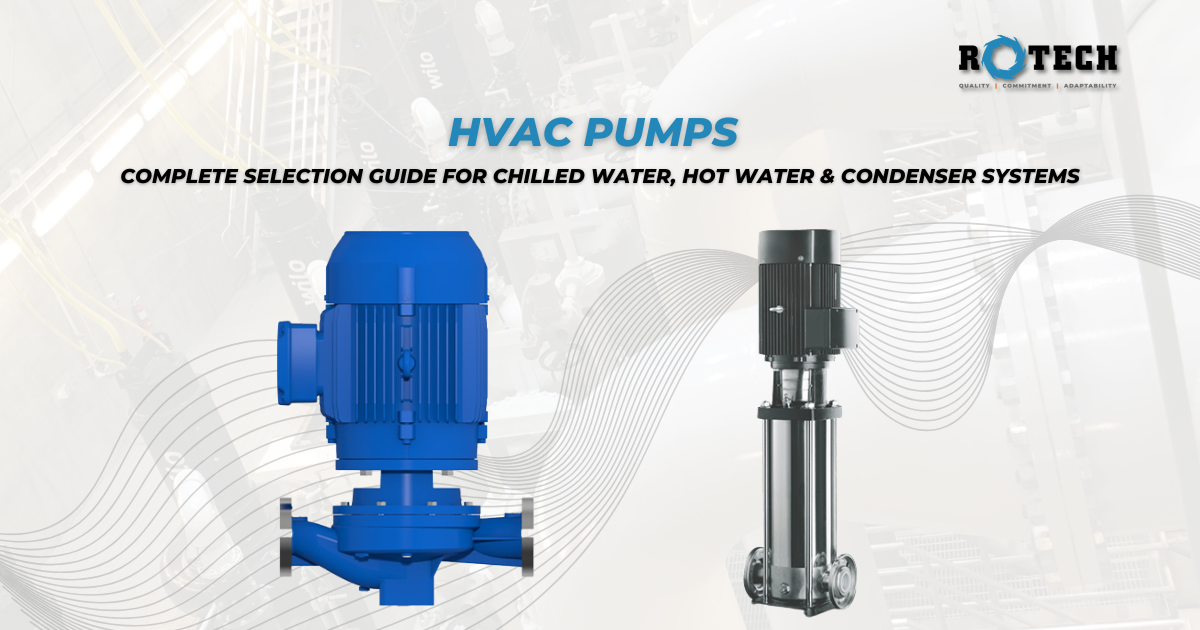
HVAC pumps are the heart of any heating, ventilation, and air conditioning system. Without them, water cannot circulate through chilled water loops, hot water systems, or condenser circuits – and your entire climate control system fails. Whether you are designing a new commercial building, upgrading an aging plant, or troubleshooting inefficiencies, choosing the right pump is critical.
This guide covers everything you need to know: the main types of HVAC pumps, how each one works, which applications they suit best, key selection criteria, energy efficiency considerations, and maintenance essentials. By the end, you will have a clear roadmap to select the right pump for your system.
What Are HVAC Pumps?
HVAC pumps are mechanical devices that circulate water or fluid through heating and cooling systems. They maintain the flow rate and pressure needed to transfer thermal energy between components – chillers, boilers, cooling towers, air handlers, and fan coil units.
In a typical commercial HVAC system, pumps move fluid through three main circuits:
- Chilled water systems – circulate cold water from chillers to air handling units to cool building spaces
- Hot water systems – circulate heated water from boilers to radiators, fan coils, or radiant panels
- Condenser water systems – move water between chillers and cooling towers to reject heat
The pump you choose for each circuit has a direct impact on system efficiency, reliability, and operating cost. According to the U.S. Department of Energy, pumping systems account for nearly 20% of industrial electricity consumption, making the right selection financially significant.
Types of HVAC Pumps
Most HVAC systems use centrifugal pumps because they handle the continuous, variable-flow conditions of water circulation extremely well. Within that category, several subtypes exist, each suited to specific installations.
1. End Suction Pumps
End suction pumps are the most common pump type in HVAC applications. Fluid enters the pump axially (from the end) and exits radially through the volute casing. They are compact, simple to maintain, and cost-effective for a wide range of flows and pressures.
They are a natural fit for:
- Chilled water distribution in mid-size commercial buildings
- Hot water heating systems in schools, offices, and hotels
- Condenser water pumping where flow rates are moderate
If you want a deeper understanding of how they work and where they fit, read our detailed post on what is an end suction pump and the pros and cons of end suction pumps.
Typical specifications for HVAC end suction pumps:
| Parameter | Typical Range |
| Flow rate | 10 – 5,000 GPM |
| Head | Up to 500 feet |
| Temperature range | 14°F to 250°F |
| Efficiency | 70 – 85% |
2. Inline Pumps (Vertical Inline Pumps)
Inline pumps have their suction and discharge ports on the same centerline, allowing them to sit directly in the pipeline without a separate base frame. This makes them ideal for tight mechanical rooms where floor space is at a premium.
They are widely used in:
- Secondary chilled water loops
- Hot water distribution in multi-story buildings
- Fan coil unit circuits
Their vertical design also reduces vibration transmission into the building structure – an important consideration in commercial construction. You can see a related comparison in our article on end suction pumps vs inline pumps.
3. Split Case Pumps (Double Suction Pumps)
Split case pumps feature a horizontally split casing, meaning you can access the impeller and internals without disconnecting the piping. The double suction design draws fluid in from both sides of the impeller, which reduces radial thrust and extends bearing life.
These pumps handle:
- Large-scale chilled water primary loops in hospitals and campuses
- High-flow condenser water applications
- Central plant systems where reliability is non-negotiable
If you are deciding between split case and end suction, our guide on end suction pumps vs split case pumps lays out the tradeoffs in plain terms.
4. Vertical Centrifugal Pumps
Vertical pumps have a vertical shaft orientation, with the motor mounted directly above the pump casing. They take up very little floor footprint and work well in sumps, wet pits, and basement mechanical rooms.
Common HVAC applications include:
- Condenser water sump pumping
- Cooling tower basin circulation
- Secondary distribution in tall buildings
For a solid introduction to this pump family, see our guide to vertical centrifugal pumps.
5. Multistage Pumps
Multistage pumps use two or more impellers in series, with each stage adding pressure to the fluid. This makes them the right choice when your system needs high head with relatively low flow – such as tall high-rise buildings where the pump must overcome significant static pressure from vertical height.
6. Self-Priming Pumps
In most HVAC systems, pumps are flooded – meaning water fills the casing before startup. But in some retrofit or remote installations, you may encounter situations where the pump sits above the water source. Self-priming pumps can draw fluid up from below without manual priming, making them practical for these scenarios.
Learn more about how they work and where they fit in our guide on self-priming pumps vs centrifugal pumps.
HVAC Pump Applications Explained
Chilled Water Systems
Chilled water HVAC systems cool water to roughly 42–55°F (6–13°C) and circulate it to air handling units across a building. The pump must maintain consistent flow and pressure across the loop even as cooling demand changes throughout the day.
Primary-secondary and variable primary configurations are common in modern energy-efficient designs. Variable speed drives (VSDs) are typically paired with centrifugal pumps in these systems because they allow flow to be reduced during partial load – saving significant energy. The Hydraulic Institute reports that using VSDs on pump motors can cut energy use by 30–50% depending on the load profile.
Pump selection for chilled water:
- Flow range – sized to the full cooling load with adequate margin
- Differential pressure – must overcome pipe friction, valves, coils, and fittings across the longest loop
- Glycol compatibility – many chilled water systems use glycol antifreeze, which increases fluid viscosity and requires a pump derated accordingly
Hot Water Heating Systems
Low-temperature hot water (LTHW) systems typically circulate water at 140–180°F (60–82°C). Medium-temperature systems can run higher. The pump must handle thermal expansion of the fluid and be rated for the operating temperature.
Cast iron is adequate for standard hot water service. For higher temperatures or chemically treated water, cast steel or stainless internals may be needed. Mechanical seals must be rated for the operating temperature – a point that is often overlooked in replacement situations.
Condenser Water Systems
Condenser water systems reject heat from the chiller to a cooling tower. Water typically circulates at 85–95°F (29–35°C) – warm but not extreme. However, these systems are often exposed to treated water with scale and corrosion inhibitors, so materials selection matters.
Condenser water pumps also tend to run at full speed for most of their operating hours, unlike chilled water pumps which often modulate. This makes impeller trim and pump curve selection especially important to avoid running too far off the best efficiency point (BEP).
Key Factors When Selecting HVAC Pumps
Getting pump selection right the first time saves money, reduces downtime, and avoids efficiency losses. Here are the factors that matter most.
Flow Rate (GPM or m³/h)
Flow rate is determined by the system’s heating or cooling load. Use the heat transfer equation:
Q = m × Cp × ΔT
Where Q is heat load (BTU/hr or kW), m is mass flow rate, Cp is specific heat of water, and ΔT is the temperature difference between supply and return. Once you know the required flow, add a modest safety margin – typically 10–15% – but avoid over-sizing, which pushes the pump off its best efficiency point.
Total Dynamic Head (TDH)
Head is the total pressure the pump must overcome, expressed in feet or meters. It includes:
- Static head – difference in elevation between supply and return points
- Friction head – pressure losses from pipe length, diameter, bends, valves, and fittings
- Equipment head – pressure drops across coils, heat exchangers, and other components
Use pipe sizing software or the Darcy-Weisbach equation to calculate friction losses accurately. Underestimating head leaves you with inadequate flow. Overestimating it leads to an oversized pump running inefficiently.
Pump Curve and System Curve
The pump curve shows how head varies with flow for a given pump and speed. The system curve shows how the required head increases with flow through your piping network. The operating point is where the two curves intersect.
Understanding this relationship is fundamental to proper selection. A pump operating far from its BEP runs hot, consumes excess energy, and experiences accelerated wear. For a visual and practical breakdown, see our article on pump curves for centrifugal pumps.
NPSH (Net Positive Suction Head)
NPSH is the margin of pressure above vapor pressure available at the pump inlet. If available NPSH (NPSHa) falls below the required NPSH (NPSHr) of the pump, cavitation occurs – vapor bubbles form and collapse violently inside the pump, causing noise, vibration, and accelerated impeller wear.
HVAC pumps are generally installed in flooded suction configurations that provide adequate NPSHa, but always verify this, especially in retrofits or elevated equipment rooms. Our article on how to prevent cavitation in centrifugal pumps covers the causes and solutions in detail.
Materials of Construction
For standard chilled and hot water systems, cast iron casings with bronze or stainless steel impellers are the typical standard. For systems using aggressive water treatment chemicals, stainless steel or specialty alloy construction may be required.
Always check the compatibility of seals, O-rings, and gaskets with the fluid and water treatment chemistry in use.
Motor Efficiency and Variable Speed Drives
In commercial HVAC, the motor is often the largest energy consumer. Specify NEMA Premium or IE3/IE4 efficiency class motors. Pair them with VSDs on primary and secondary distribution pumps to take advantage of the affinity laws – reducing pump speed by just 20% cuts power consumption by nearly 49%.
ANSI vs Non-ANSI Pumps
ANSI (American National Standards Institute) pumps follow standardized dimensional footprints, meaning a pump from one manufacturer can replace one from another with no piping changes. This is a significant advantage in commercial HVAC and process applications where long-term serviceability matters.
For a thorough comparison with API-rated pumps, see our post on the difference between ANSI pumps and API pumps.
HVAC Pump Configurations: Primary, Secondary, and Variable Primary
Modern commercial HVAC plants use several piping and pump configurations to balance efficiency and controllability.
Primary-Only Systems
A single set of pumps circulates water from the chiller through the distribution system and back. Simple and low capital cost, but energy efficiency suffers at partial load because pump speed must be controlled carefully to maintain minimum chiller flow.
Primary-Secondary Systems
Two pump sets operate independently:
- Primary pumps – dedicated to the chiller circuit, maintaining constant flow through the chiller at all times
- Secondary pumps – dedicated to the distribution system, varying flow to meet changing load
A common header connects both loops. Secondary pumps with VSDs can reduce speed as building load drops, saving energy while the primary loop maintains stable chiller operation. This was the dominant configuration in commercial buildings for two decades.
Variable Primary Systems
Advances in chiller controls now allow flow through the chiller itself to vary. This eliminates the need for a secondary pump set, reducing capital cost and pump energy. However, it requires careful controls design to prevent flow from dropping below the chiller’s minimum safe flow rate.
Energy Efficiency in HVAC Pumping Systems
Energy efficiency is not optional in modern commercial building design. ASHRAE 90.1 sets minimum efficiency standards for HVAC systems, including pumping. Buildings pursuing LEED certification or energy benchmarking under ENERGY STAR must demonstrate pump system efficiency as part of their energy model.
Key efficiency strategies include:
- Right-size the pump. An oversized pump operates left of its BEP, wasting energy and increasing wear. Size to the actual system requirement, not a heavily padded estimate.
- Use variable speed drives. VSDs are the single highest-impact efficiency measure for most HVAC pumping systems. Pair them with pressure differential sensors to enable true demand-based control.
- Reduce system resistance. Every elbow, valve, and fitting adds friction. Larger pipe diameters, full-port valves, and efficient fittings all reduce the system curve, allowing a smaller pump to do the same job.
- Optimize impeller trim. If your pump consistently runs at a lower flow than its rated point, trim the impeller to match. This is a low-cost modification that can meaningfully reduce energy consumption.
- Monitor performance continuously. Pump efficiency degrades over time as wear occurs. IoT-based monitoring systems can alert you to performance drift before it becomes a failure.
Our resource on efficient ways to increase the performance of pumping systems gives you a practical action list.
HVAC Pump Installation Best Practices
Even the right pump, poorly installed, will underperform. Follow these guidelines to protect your investment.
- Support piping independently – never let the pipe weight hang on the pump flanges, as this causes misalignment and premature seal failure
- Align the coupling carefully – angular and parallel misalignment are leading causes of bearing and seal failure; use a dial indicator or laser alignment tool
- Maintain straight pipe at suction – install at least 5 pipe diameters of straight pipe before the pump suction to ensure even flow distribution and prevent pre-swirl
- Install isolation valves – gate or butterfly valves on suction and discharge allow pump removal without draining the entire system
- Install a suction strainer – protects the impeller from debris, especially during commissioning
For a step-by-step breakdown of installation and ongoing care, see our end suction pump installation and maintenance guide.
HVAC Pump Maintenance Checklist
Regular maintenance keeps your pumps running efficiently and extends service life. Here is what to check and when:
Daily/Weekly:
- Check for leaks at mechanical seal and pipe joints
- Listen for unusual noise or vibration
- Verify motor amperage is within nameplate rating
- Confirm flow and pressure are at design values
Monthly:
- Inspect coupling for wear or misalignment signs
- Check bearing temperature – most pump bearings should run no more than 30–40°F above ambient
- Lubricate bearings per manufacturer schedule (for grease-lubricated types)
- Inspect strainer and clean if pressure drop has increased
Annually:
- Perform full alignment check with laser or dial indicator
- Inspect impeller and casing wear rings
- Inspect and replace mechanical seal if leakage is evident
- Review pump performance against original curve – efficiency loss of more than 5% may indicate internal wear
For a complete maintenance reference, our centrifugal pump maintenance checklist is a practical starting point.
Common HVAC Pump Problems and Solutions
| Problem | Likely Cause | Solution |
| Low flow or pressure | Impeller wear, air lock, closed valve | Check valve positions, purge air, inspect impeller |
| Excessive noise/vibration | Cavitation, misalignment, worn bearings | Check NPSH, realign, replace bearings |
| Seal leakage | Worn seal faces, improper installation | Replace mechanical seal |
| Motor overload | Pump operating far left of BEP, oversized pump | Trim impeller, install VSD, recheck system curve |
| Overheating | Insufficient flow, wrong lubrication, bearing failure | Check for blocked strainer, verify lubrication schedule |
| Short bearing life | Misalignment, excessive radial load | Laser align, verify pump is not operating far from BEP |
Learning to read these warning signs early saves you from a full replacement. Our guide on how to avoid common pumping mistakes covers the most frequent errors engineers and operators make.
Mechanical Seals for HVAC Pumps
Mechanical seals prevent the pumped fluid from leaking along the rotating shaft. In HVAC applications, the standard mechanical seal works well for clean, treated water service. However, if your system runs glycol, scale inhibitors, or is subject to high temperatures, you need to verify seal face and elastomer compatibility.
Common seal configurations for HVAC pumps include:
- Single spring elastomer bellows seals – cost-effective, widely used in standard chilled and hot water service
- Cartridge seals – self-contained units that simplify installation and reduce the risk of incorrect assembly, preferred in critical or hard-to-access applications
- Balanced seals – used in higher-pressure applications where unbalanced seals would have excessive face loading
Rotech stocks a comprehensive range of mechanical seals including single spring elastomer bellows seals and single cartridge seals with flush, suitable for a wide range of HVAC pump models.
How to Select the Right HVAC Pump: A Step-by-Step Summary
- Define the system – chilled water, hot water, or condenser water; primary, secondary, or variable primary
- Calculate the required flow rate – based on the system’s peak heat load and target temperature difference
- Calculate the total dynamic head – friction losses, elevation changes, and equipment pressure drops
- Check NPSH – verify NPSHa exceeds NPSHr by an adequate margin (typically 2–3 feet minimum)
- Select pump type – end suction for most applications, split case for high flow, inline for space-constrained installations, multistage for high head
- Check materials – cast iron for standard water service, stainless for aggressive chemistry
- Specify motor efficiency class and VSD compatibility
- Verify ANSI compliance if long-term interchangeability is a priority
- Confirm seal type – matched to temperature, pressure, and fluid chemistry
- Plan for maintenance – ensure access for alignment, seal replacement, and impeller inspection
For a structured approach to pump selection across all pump types, our guide on how to select the right pump walks through the process in detail.
FAQ: HVAC Pumps
What type of pump is most commonly used in HVAC systems?
Centrifugal pumps – specifically end suction and inline centrifugal pumps – are the most widely used pump types in HVAC systems. They handle the continuous water circulation required in chilled water, hot water, and condenser water loops effectively and are available in a wide range of sizes and configurations to match different building types and load profiles.
What is the difference between a primary pump and a secondary pump in an HVAC system?
A primary pump is dedicated to circulating water through the chiller or boiler at a constant flow rate to maintain stable equipment operation. A secondary pump circulates water from the central plant to the building’s distribution system, often at variable flow using a variable speed drive, to match actual building load. The two loops are connected by a common header that allows flow to balance between them.
How do I size a pump for a chilled water system?
Start with the system’s peak cooling load in BTU/hr or tons. Use the formula GPM = (Tons × 24) ÷ ΔT (in °F) to get the required flow rate. Then calculate the total dynamic head by adding friction losses in the longest pipe run, plus pressure drops through coils, valves, and fittings. Plot this on pump curves from shortlisted models and select the pump whose curve intersects your system curve near its best efficiency point.
Why does an HVAC pump cavitate?
Cavitation happens when the pressure at the pump inlet drops below the vapor pressure of the water. This causes vapor bubbles to form inside the pump, which then collapse violently and damage the impeller and casing. Common causes in HVAC systems include undersized suction piping, a partially closed suction valve, suction pipe running too close to a hot source, or a pump installed too far above the water source. Solving cavitation usually involves improving the suction conditions rather than changing the pump.
What is the best efficiency point (BEP) of a pump?
The best efficiency point is the flow rate at which a centrifugal pump operates with the highest hydraulic efficiency. Running a pump at or near its BEP minimizes energy waste, reduces heat generation, lowers hydraulic forces on the impeller and shaft, and significantly extends bearing and seal life. HVAC pump systems should be designed so that the pump operates at 80–110% of BEP under normal operating conditions.
Do HVAC pumps need variable speed drives?
In most modern commercial HVAC installations, variable speed drives on distribution pumps are strongly recommended and often required by energy codes such as ASHRAE 90.1. VSDs allow pump speed to be reduced as system load drops, taking advantage of the affinity laws to produce large energy savings. Fixed-speed pumps in variable flow systems waste energy through throttling control valves and should be avoided in new designs.
How often should HVAC pumps be serviced?
At a minimum, HVAC pumps should receive a thorough inspection annually, including alignment check, bearing inspection, seal check, and performance verification against the original pump curve. Monthly checks of noise, vibration, temperature, and operating current are also recommended. Mechanical seals typically last 3–5 years in clean water service but should be inspected annually once they reach 2 years of service.
What is the difference between ANSI pumps and standard HVAC pumps?
ANSI pumps conform to ANSI/HI 9.6.1 dimensional standards, which means pumps from different manufacturers share the same mounting footprint, shaft location, and flange positions. This allows for direct replacement without re-piping. Standard HVAC pumps may follow proprietary dimensions, making exact replacement necessary when a unit fails. ANSI-dimensioned pumps offer a significant advantage in serviceability for commercial buildings where long-term maintenance cost matters.
Rotech Pumps: Your HVAC Pumping Partner
Selecting, sourcing, and maintaining HVAC pumps across a large building portfolio is complex work. Rotech Pumps brings together an extensive product range – from ANSI-standard end suction pumps and vertical inline pumps to split case pumps and vertical multistage pumps – with the technical knowledge to help you match the right pump to your specific system. Rotech also stocks a full range of mechanical seals, base frames, couplings, and accessories to support complete pump package builds and field servicing. Whether you are specifying for a new central plant, replacing aging equipment, or troubleshooting a chronic efficiency problem, Rotech’s team has the product depth and application experience to help you get it right.
Submit a pump inquiry to get started, or contact the Rotech team directly to discuss your HVAC pumping requirements.
Sources:
- U.S. Department of Energy – Pump Systems: https://www.energy.gov/eere/amo/pump-systems
- Hydraulic Institute – Pump Efficiency Standards: https://www.pumps.org/
- ASHRAE 90.1 – Energy Standard for Buildings Except Low-Rise Residential Buildings
Recent Posts
Centrifugal Pump Installation Guide: Step-by-Step Best Practices
A centrifugal pump installation has
Chemical Compatibility Guide: Pump Materials for Common Industrial Chemicals
Picking the wrong pump material
Chemical Pump Troubleshooting: Diagnosing Common Failures
Chemical pumps work hard. They