
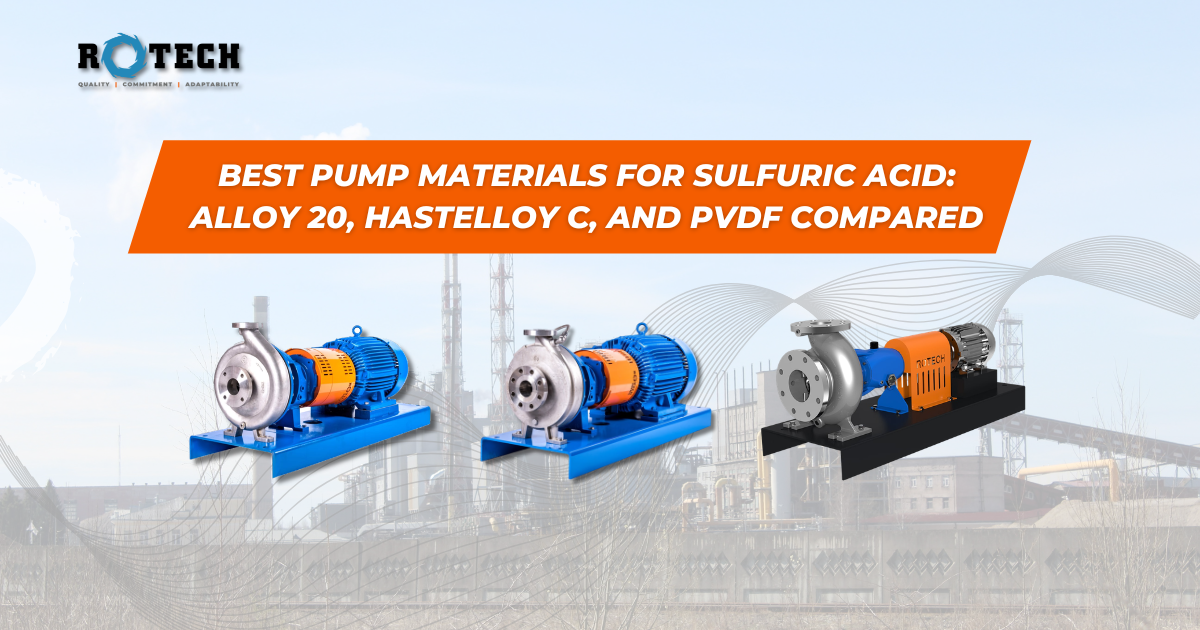
Choosing the wrong material for a sulfuric acid pump is an expensive mistake. In mild cases, you get accelerated corrosion, shortened service life, and unexpected maintenance costs. In serious cases, you get a structural failure, a dangerous leak, and a potential safety incident involving one of the most hazardous chemicals in industrial use.
The challenge is that sulfuric acid does not behave like a single, predictable fluid. Its corrosivity changes dramatically across concentration levels, and it behaves differently at different temperatures and flow velocities. A material that holds up perfectly at one concentration can dissolve rapidly if the concentration shifts. This is why engineers who work with H₂SO₄ regularly treat material selection as the most critical step in pump specification – not an afterthought.
This article gives you a direct, practical comparison of the three materials that dominate sulfuric acid pump applications: Alloy 20, Hastelloy C-276, and PVDF. It also covers the materials that are commonly misapplied – including carbon steel and 316L stainless steel – so you know exactly where each one fails and why. By the end, you will have a clear framework for matching pump material to your specific acid conditions.
Why Sulfuric Acid Is Uniquely Challenging for Pump Materials
Sulfuric acid is the world’s most produced industrial chemical. According to the U.S. Geological Survey, global sulfuric acid production exceeds 200 million metric tons annually, with applications spanning fertilizer manufacturing, battery production, mineral processing, petroleum refining, and chemical synthesis. That scale means pump engineers encounter H₂SO₄ across a huge range of conditions – and material decisions matter enormously at every point in the concentration spectrum.
The reason sulfuric acid is so difficult to contain in common metals comes down to electrochemistry. Dilute sulfuric acid (roughly below 50%) is a strongly reducing acid that attacks iron and steel by stripping electrons from the metal surface in a continuous oxidation reaction. The acid does not slow down – it accelerates as the corroded metal surface becomes rougher and more reactive.
Counterintuitively, concentrated sulfuric acid (above approximately 93%) is far less corrosive to carbon steel. At high concentrations, the acid reacts with the steel surface to form a dense iron sulfate film that blocks further attack – a process called passivation. This is why carbon steel storage tanks and pumps have been used for concentrated H₂SO₄ for over a century.
But this passivation breaks down sharply if:
- Temperature rises above about 40°C (104°F)
- Flow velocity is high enough to strip the passive layer from the surface
- The acid concentration drops – even temporarily – below the passivation threshold
That last point creates real operational risk. A system designed and built for concentrated acid service can experience rapid corrosion failure if dilution occurs – from condensation, process upset, or an upstream change. Material selection must account for the full range of conditions a pump might realistically encounter, not just the nominal design point.
Temperature compounds the challenge across the entire concentration range. Virtually every material’s corrosion resistance deteriorates as temperature increases. A material rated for 70°C service at a given acid concentration may fail within months if the temperature reaches 90°C.
The Materials That Work – and Those That Don’t
Before comparing the top three materials in depth, it is worth being clear about what does not work in sulfuric acid service, because these materials appear in specifications frequently – often incorrectly.
Carbon Steel: Limited to Specific Concentrated Acid Conditions
Carbon steel can handle concentrated sulfuric acid (93 to 98%) at temperatures below 40°C (104°F) and moderate velocities due to the passivation mechanism described above. In these narrow conditions, it is actually an economical and proven choice for storage vessels and pipework.
Outside those conditions – particularly in dilute and intermediate concentrations covering most battery acid and process acid applications – carbon steel corrodes rapidly. It is not an acceptable material for battery acid (typically 29 to 37% H₂SO₄) or for any application where acid concentration or temperature might vary.
316L Stainless Steel: Widely Misapplied in Acid Service
316L stainless steel is the default “chemical service” material in many industries, and it performs well against a wide range of corrosive fluids. Sulfuric acid across most of its concentration range is not one of them.
316L stainless steel has reliable resistance only at very dilute concentrations (below approximately 5%) and at the high end of concentration (above approximately 95%) – and even then, only at low temperatures. In the 10 to 90% concentration range that covers most industrial acid applications, 316L corrodes significantly and should not be specified. Its presence in pump casings for general acid service is one of the most common and costly material specification errors in the field.
Titanium: Useful but Concentration-Dependent
Titanium offers excellent resistance to dilute sulfuric acid below about 10% at ambient temperatures, and to some higher concentrations in the presence of oxidizing agents. However, it corrodes rapidly in intermediate and concentrated H₂SO₄ without those oxidizing conditions present. Titanium is a niche choice for specific dilute acid conditions rather than a general solution for the sulfuric acid concentration range.
Alloy 20 (UNS N08020): The Purpose-Built Sulfuric Acid Alloy
What It Is
Alloy 20 is a nickel-iron-chromium alloy with deliberate additions of copper (3 to 4%) and molybdenum (2 to 3%). It was developed specifically in the mid-20th century to solve the problem of sulfuric acid corrosion in chemical process equipment. Its composition – particularly the copper content – provides resistance to the reducing acid attack that destroys stainless steel in the dilute to intermediate concentration range.
Typical composition: 32 to 38% Nickel, 19 to 21% Chromium, 2 to 3% Molybdenum, 3 to 4% Copper, balance Iron.
Where It Performs Well
Alloy 20 provides reliable corrosion resistance across a wide band of sulfuric acid conditions:
- Concentration range: 5% to 98% H₂SO₄, with outstanding performance in the 10 to 70% range where most industrial and battery acid applications fall
- Temperature range: Up to approximately 66°C (150°F) across most of the concentration range, with lower limits at intermediate concentrations
- Flow velocity: Handles normal pump velocities without erosion-corrosion issues at compatible concentrations and temperatures
This range covers the vast majority of battery acid service (29 to 37%), most chemical processing acid streams, fertilizer production, and acid cleaning applications. It is the most commonly specified alloy for chemical process pumps in sulfuric acid service for good reason.
Limitations of Alloy 20
Alloy 20 is not unlimited in its resistance. At elevated temperatures – particularly above 60 to 66°C – corrosion rates increase meaningfully in intermediate acid concentrations. In hot, concentrated, or highly contaminated acid streams, Hastelloy C-276 is the more appropriate specification. Alloy 20 also has limits under strong oxidizing conditions that may be present in certain process streams.
Cost Consideration
Alloy 20 is significantly more expensive than stainless steel – typically 3 to 4 times the cost of 316L for equivalent pump components. However, compared to Hastelloy C-276, it is substantially more economical. For most battery acid and standard industrial acid applications, Alloy 20 delivers the required corrosion resistance at a lower cost than exotic alloys.
Best-Fit Applications for Alloy 20 Pumps
- Battery acid transfer and recirculation (29 to 37% H₂SO₄)
- Fertilizer production acid systems (phosphoric acid, sulfuric acid blends)
- Chemical process feed and recirculation at moderate temperatures
- Acid cleaning systems in metal finishing
- Pickling operations in steel processing
The Rotech 1196 ANSI series pumps and Rochem series frame-mounted pumps are available in Alloy 20 construction for these applications. For a deeper look at how ANSI pump standards affect long-term serviceability in corrosive service, our complete guide to ANSI pumps is a useful companion read.
Hastelloy C-276 (UNS N10276): Maximum Resistance for Demanding Conditions
What It Is
Hastelloy C-276 is a nickel-molybdenum-chromium superalloy with high molybdenum content (15 to 17%) and additions of tungsten (3 to 4.5%). It is one of the most corrosion-resistant metallic alloys available for industrial service, offering resistance to an exceptionally broad range of aggressive chemicals – including sulfuric acid at virtually all concentrations and temperatures encountered in industrial practice.
Typical composition: 57% Nickel (balance), 15 to 17% Molybdenum, 14.5 to 16.5% Chromium, 3 to 4.5% Tungsten, 4 to 7% Iron.
Where It Performs Well
Hastelloy C-276 extends the performance envelope significantly beyond Alloy 20:
- Concentration range: Resistant across the full industrial range, including oleum (fuming sulfuric acid) and all intermediate concentrations
- Temperature range: Reliable performance to 120°C (248°F) and beyond in many acid concentrations – significantly higher than Alloy 20’s practical limits
- Contaminated streams: Handles acid streams containing chlorides, oxidizing agents, or mixed chemical contamination that would accelerate corrosion even in Alloy 20
- High-velocity applications: Its resistance to erosion-corrosion makes it suitable for high-flow-velocity situations that would challenge other alloys
Hastelloy C-276 is the material engineers specify when conditions push beyond the reliable performance band of Alloy 20: when temperatures are elevated, when acid concentrations are at the extremes, when stream chemistry is complex, or when the cost of pump failure is high enough to justify spending more upfront for the most resistant material available.
Limitations of Hastelloy C-276
The primary limitation of Hastelloy C-276 is cost. It is typically 5 to 8 times the cost of 316L stainless steel and 1.5 to 2.5 times the cost of Alloy 20 for equivalent components. For applications where Alloy 20 provides adequate corrosion resistance, the additional cost of Hastelloy C-276 does not deliver proportional value.
Hastelloy C-276 also has limits – primarily in strong oxidizing acid environments at extreme temperatures. In virtually all industrial sulfuric acid service, however, it provides more than adequate resistance.
Best-Fit Applications for Hastelloy C-276 Pumps
- Hot sulfuric acid transfer above 60°C (140°F)
- Concentrated acid service (above 80% H₂SO₄) at elevated temperatures
- Mixed acid streams containing chlorides alongside H₂SO₄
- Oleum (fuming sulfuric acid) handling
- High-velocity acid recirculation where erosion-corrosion is a risk
- Critical production lines where pump failure cost is very high and downtime is not acceptable
- Applications where acid concentration can vary widely and unpredictably
The Rochem CC series close-coupled pumps are available in Hastelloy construction for demanding chemical process applications.
PVDF (Polyvinylidene Fluoride): The High-Performance Thermoplastic Option
What It Is
PVDF is a semi-crystalline thermoplastic fluoropolymer – a member of the same chemical family as PTFE (Teflon), though with different physical properties. Unlike PTFE, which is difficult to machine or mold into complex shapes, PVDF can be injection-molded, extruded, and machined precisely. This makes it practical for pump casings, impellers, and lined components.
PVDF’s chemical resistance comes from its carbon-fluorine backbone – one of the strongest chemical bonds in organic chemistry. Fluorine essentially shields the carbon chain from chemical attack across a very wide range of corrosive chemicals.
Where PVDF Performs Well
PVDF delivers chemical resistance that metallic alloys cannot match in some respects, particularly around purity and weight:
- Concentration range: Excellent resistance to sulfuric acid from dilute concentrations up to approximately 70% H₂SO₄. Above 70%, attack becomes significant and PVDF is not suitable.
- Temperature range: Rated to 120°C (248°F) in many acid services at low pressure – higher than Alloy 20 in overlapping concentration ranges
- Purity: Because PVDF does not corrode, it does not introduce metal ions into the fluid. In battery manufacturing, semiconductor production, and pharmaceutical applications, metal contamination in the acid is unacceptable. PVDF solves this problem entirely.
- Weight: PVDF pump components are significantly lighter than equivalent metal alloy components – relevant in installations where weight loading matters
- Electrical isolation: PVDF is non-conductive, which is useful in battery and electrochemical applications where electrical isolation of wetted components is required
Limitations of PVDF
PVDF has real limitations that make it unsuitable for some acid service environments:
- Concentration ceiling: Above approximately 70% H₂SO₄, PVDF is attacked. It is not suitable for concentrated or oleum service.
- Mechanical strength: PVDF is significantly weaker than metallic alloys under mechanical load. Maximum allowable working pressure is lower than equivalent metal pump ratings, and susceptibility to creep – slow deformation under sustained load – increases at elevated temperatures.
- Certain organic contaminants: Some organic solvents and esters attack PVDF even though it resists acids well. Verify compatibility if your acid stream contains organic contamination.
- Temperature-pressure interaction: While PVDF handles high temperatures in low-pressure acid service, its pressure rating drops significantly as temperature rises. Always check the combined pressure-temperature rating, not temperature alone.
- Impact resistance: PVDF is more brittle than metals and can crack under mechanical impact – a consideration in installations where physical damage from handling or dropped tools is possible.
Best-Fit Applications for PVDF Pumps
- Battery acid transfer where metal ion contamination must be avoided
- Semiconductor and electronics acid handling (HF, dilute H₂SO₄)
- Laboratory acid transfer and metering
- Pharmaceutical acid process applications
- Installations requiring non-conductive wetted components
- Applications where weight saving is important
- Acid concentrations up to 70% at moderate pressures
Side-by-Side Material Comparison
Property | Alloy 20 | Hastelloy C-276 | PVDF |
Max H₂SO₄ concentration | 98% (at low temp) | 100% (all conditions) | ~70% |
Max service temperature | ~66°C (150°F) | ~120°C (248°F) | ~120°C (low pressure) |
Battery acid (30–37%) | Excellent | Excellent | Excellent |
Intermediate acid (50–80%) | Good to Excellent | Excellent | Good (to 70%) |
Concentrated acid (93–98%) | Good (low temp) | Excellent | Not suitable |
Chloride contamination resistance | Moderate | Excellent | Excellent |
Metal ion contamination of fluid | Yes | Yes | None |
Max working pressure | High | High | Moderate |
Relative material cost | Moderate-High | Very High | Moderate |
Weight vs 316L | Similar | Similar | Much lighter |
Electrical conductivity | Conductive | Conductive | Non-conductive |
Best fit summary | Industrial acid, battery acid, chemical process | Hot/concentrated/complex acid, critical service | Purity-critical, concentrations below 70%, lightweight |
How to Choose Between These Three Materials
The decision between Alloy 20, Hastelloy C-276, and PVDF comes down to four questions. Work through them in order and the selection becomes straightforward.
Question 1: What is the acid concentration range – including worst case?
If your acid stays reliably below 70% H₂SO₄ and purity matters, PVDF is a serious option. If your concentration reaches or exceeds 70%, or if it can vary into the 70 to 98% range, PVDF is ruled out and you are choosing between metallic alloys.
Question 2: What is the operating temperature – including the maximum possible?
If your system reliably operates below 60°C (140°F), Alloy 20 covers most concentration ranges adequately. If temperatures reach 70°C or above, or if there is any possibility of higher temperatures during process upset, specify Hastelloy C-276.
Question 3: Does your acid stream contain chlorides or other aggressive contaminants?
Chlorides accelerate corrosion in metallic alloys. Alloy 20 has moderate chloride resistance, but mixed acid streams with meaningful chloride contamination call for Hastelloy C-276’s superior resistance. PVDF is unaffected by chlorides.
Question 4: What are the consequences and cost of pump failure?
If your production process stops when a pump fails, and if the pump is difficult to access or replace, the incremental cost of Hastelloy C-276 over Alloy 20 may be justified purely on reliability grounds – even if Alloy 20 is technically adequate. This is a business decision as much as an engineering one.
Decision Quick Reference
Your Situation | Recommended Material |
Battery acid (30–37%), ambient temperature, standard service | Alloy 20 |
Battery acid, purity critical (no metal ions), moderate pressure | PVDF |
Intermediate acid (50–70%), ambient to moderate temperature | Alloy 20 or PVDF |
Hot acid above 60°C at any concentration | Hastelloy C-276 |
Concentrated acid above 80% | Hastelloy C-276 |
Mixed acid with chloride contamination | Hastelloy C-276 |
Critical service, high downtime cost | Hastelloy C-276 |
Low-flow dosing, contamination-sensitive | PVDF or mag drive in Hastelloy |
For a broader look at how to transfer corrosive chemicals safely through centrifugal pumping systems, our guide on how to transfer corrosive chemicals safely using centrifugal pumps covers the key principles that apply alongside material selection.
Seal and Gasket Materials: Completing the Compatibility Picture
Selecting the right casing and impeller material is necessary but not sufficient. Every wetted component in the pump must be compatible with your acid conditions. This includes mechanical seal faces, elastomeric O-rings and bellows, gaskets, and shaft sleeve.
Mechanical seal faces for sulfuric acid service should default to silicon carbide versus silicon carbide. This combination provides chemical resistance across the full concentration range and handles the minor abrasives often present in process acid streams. Carbon graphite faces are compatible in many acid concentrations but should be verified against your specific conditions and avoided in strongly oxidizing environments.
Elastomers are often the weak link in acid pump sealing. PTFE is the most chemically inert option and is compatible with sulfuric acid at virtually all concentrations – always the safest specification. Viton (FKM) handles dilute and intermediate concentrations but is attacked by concentrated H₂SO₄. EPDM is not suitable for any sulfuric acid service and must not be specified. Buna-N (NBR) is similarly unsuitable.
Gaskets in flanged connections should be PTFE or expanded PTFE for acid service. Compressed fiber or standard rubber gaskets are not appropriate.
Cartridge seals deserve a strong recommendation in acid applications specifically because they eliminate the risk of incorrect assembly – a pre-set, self-contained unit that installs without requiring precise measurement of seal face loading in the field. Incorrect assembly of a component seal in acid service can result in immediate failure and a hazardous leak on startup.
Rotech’s range of PTFE bellow seals, elastomer bellow seals, balanced seals, and cartridge seals covers the configurations used across sulfuric acid pump applications.
Temperature and Velocity: The Two Variables Most Often Overlooked
Material compatibility data published by alloy manufacturers is almost always generated at ambient temperature and low flow velocity under laboratory conditions. Real pumping systems operate at elevated temperatures and meaningful flow velocities. Both factors accelerate corrosion in ways that can make a nominally compatible material perform poorly in the field.
Temperature Effects on Corrosion Rate
The general rule in corrosion engineering is that corrosion rate roughly doubles for every 10°C (18°F) increase in temperature. A material that corrodes at an acceptable rate at 25°C may corrode four times faster at 45°C – potentially crossing from adequate service life to unacceptable service interval. Always design for the maximum credible operating temperature, not the target temperature.
Velocity and Erosion-Corrosion
At high flow velocities, the protective surface films that give alloys like Alloy 20 much of their corrosion resistance can be physically stripped from the metal surface before they can regenerate. This erosion-corrosion mechanism produces corrosion rates far higher than static immersion tests predict. As a practical guideline:
- Keep suction piping velocity below 1.5 m/s (5 ft/s) in acid service
- Keep discharge piping velocity below 3 m/s (10 ft/s)
- Pay particular attention to elbows and bends, where flow impingement concentrates erosion-corrosion damage
Pumps handling acid with suspended solids – recycled battery acid with lead particles, for example – face additional abrasion that compounds the erosion-corrosion effect. In these cases, specify harder impeller materials and plan for shorter inspection intervals.
Understanding how flow velocity and impeller design interact is covered in our article on the impeller as the soul of the centrifugal pump – a useful reference when specifying impeller materials for acid service.
Practical Specification Checklist for Sulfuric Acid Pump Materials
Use this checklist before finalizing any acid pump material specification.
Fluid definition – establish all of these before selecting any material:
- Exact H₂SO₄ concentration range: minimum, nominal, and maximum credible
- Operating temperature range, including process upset scenarios
- Specific gravity at operating conditions
- Suspended solids content and particle size if any
- Presence of chlorides, fluorides, or other co-contaminants
- Whether metal ion contamination of the fluid is acceptable
Material verification – check every wetted component, not just the casing:
- Pump casing: Alloy 20, Hastelloy C-276, PVDF, or other
- Impeller: match to casing material
- Shaft sleeve: match to casing, or specify Hastelloy for extra margin
- Mechanical seal faces: silicon carbide versus silicon carbide preferred
- Seal elastomers: PTFE preferred; verify Viton only for dilute to intermediate concentrations
- Gaskets: PTFE or expanded PTFE
Installation and safety provisions:
- Motor area classification confirmed (standard, explosion-proof, or ATEX as required)
- Secondary containment and drip tray capacity confirmed
- Emergency isolation valve on suction line
- PPE and eyewash station availability within OSHA-required distance
FAQ: Pump Materials for Sulfuric Acid
What is the best material for a sulfuric acid pump?
There is no single best material – the right choice depends on acid concentration, temperature, and application requirements. Alloy 20 is the most practical choice for most battery acid and industrial acid applications at moderate temperatures. Hastelloy C-276 is specified for hot, concentrated, or chemically complex acid streams where maximum corrosion resistance justifies higher cost. PVDF is the right choice when metal ion contamination of the fluid is unacceptable, or when the application involves concentrations below 70% at moderate pressures and a non-metallic material offers advantages the alloys cannot provide.
Why does stainless steel fail in sulfuric acid?
316L stainless steel fails in most sulfuric acid concentrations because it lacks the copper and high nickel content needed to resist reducing acid attack in the 10 to 90% concentration range. Its passive chromium oxide layer, which protects it from many corrosives, is dissolved by dilute and intermediate sulfuric acid. This is a frequent and costly specification error – stainless steel’s broad reputation as a “chemical resistant” material leads engineers to apply it where it is genuinely unsuitable.
What is the concentration limit for PVDF in sulfuric acid?
PVDF is generally suitable for sulfuric acid concentrations up to approximately 70% by weight at moderate temperatures. Above 70%, the acid attacks PVDF and corrosion becomes significant. Always verify against the specific PVDF grade’s published chemical resistance data, as formulations vary between manufacturers and temperature affects the limit.
Is Hastelloy C-276 always better than Alloy 20 for acid pumps?
Hastelloy C-276 offers broader and more robust corrosion resistance than Alloy 20, but it is not always the right choice. For most battery acid applications and industrial acid service at temperatures below 60°C (140°F), Alloy 20 provides adequate corrosion resistance at meaningfully lower cost. Hastelloy C-276 is the correct specification when temperatures are elevated, when concentrations are high or variable, when stream chemistry is complex, or when service conditions are near the boundaries of Alloy 20’s reliable performance range.
What O-ring material should I use for sulfuric acid pumps?
PTFE is the safest and most universally compatible elastomer for sulfuric acid service across all concentrations. Viton (FKM) is acceptable for dilute to intermediate concentrations but should not be used above approximately 80% H₂SO₄. EPDM is not compatible with sulfuric acid at any concentration and must not be specified in acid pump applications.
Can I use carbon steel for sulfuric acid pumps?
Carbon steel is suitable only for concentrated sulfuric acid (above 93%) at temperatures below approximately 40°C (104°F) and at moderate velocities, where passivation protects the metal surface. It is not suitable for battery acid concentrations (typically 29 to 37%), for intermediate concentrations, or for any application where concentration or temperature may vary. The risk of concentration fluctuation breaking down the passive layer makes carbon steel a poor choice for most operational sulfuric acid pumping applications outside very tightly controlled concentrated acid systems.
How do I verify my pump material is compatible with my specific acid conditions?
Start with published corrosion resistance data from the alloy or material manufacturer – most major suppliers publish detailed tables covering temperature and concentration ranges for their specific grades. Verify that your full operating range, including worst-case temperature and concentration, falls clearly within the acceptable zone – not at the boundary. Then confirm that every wetted component is compatible, not just the casing. Finally, consult with your pump supplier and, if conditions are unusual or critical, consider independent corrosion testing at your specific conditions before committing to a large installation.
Rotech Pumps: Stocking the Materials That Sulfuric Acid Service Demands
Knowing the right material is one step. Finding a supplier who stocks pumps in Alloy 20, Hastelloy C-276, and chemical-grade construction – and who can confirm the right configuration for your specific acid conditions – is the step that gets your system running safely and reliably.
Rotech stocks chemical process pumps in the corrosion-resistant materials that sulfuric acid applications require. The 1196 ANSI series and Rochem series frame-mounted pumps are available in Alloy 20 construction for battery acid and general industrial acid service. The Rochem CC close-coupled series covers applications where compact installation is required. The full acid pump product category and chemical process pump range provide additional configurations for specific application requirements.
Rotech also supplies the complete seal package to match – including PTFE bellow seals, balanced seals, and cartridge seals in configurations appropriate for acid service. For chemical pump maintenance best practices that keep your acid pump running between service intervals, our chemical pump maintenance tips article is a practical resource.
Submit a pump inquiry with your acid concentration, temperature, flow rate, and head requirements, and the Rotech team will confirm the right material and pump configuration for your application. Or contact Rotech directly to discuss your acid handling requirements.
Recent Posts
What Is a Chemical Metering Pump? Types, How They Work, and How to Size One
A chemical metering pump is

Centrifugal Pump Installation Guide: Step-by-Step Best Practices
A centrifugal pump installation has
Chemical Compatibility Guide: Pump Materials for Common Industrial Chemicals
Picking the wrong pump material