
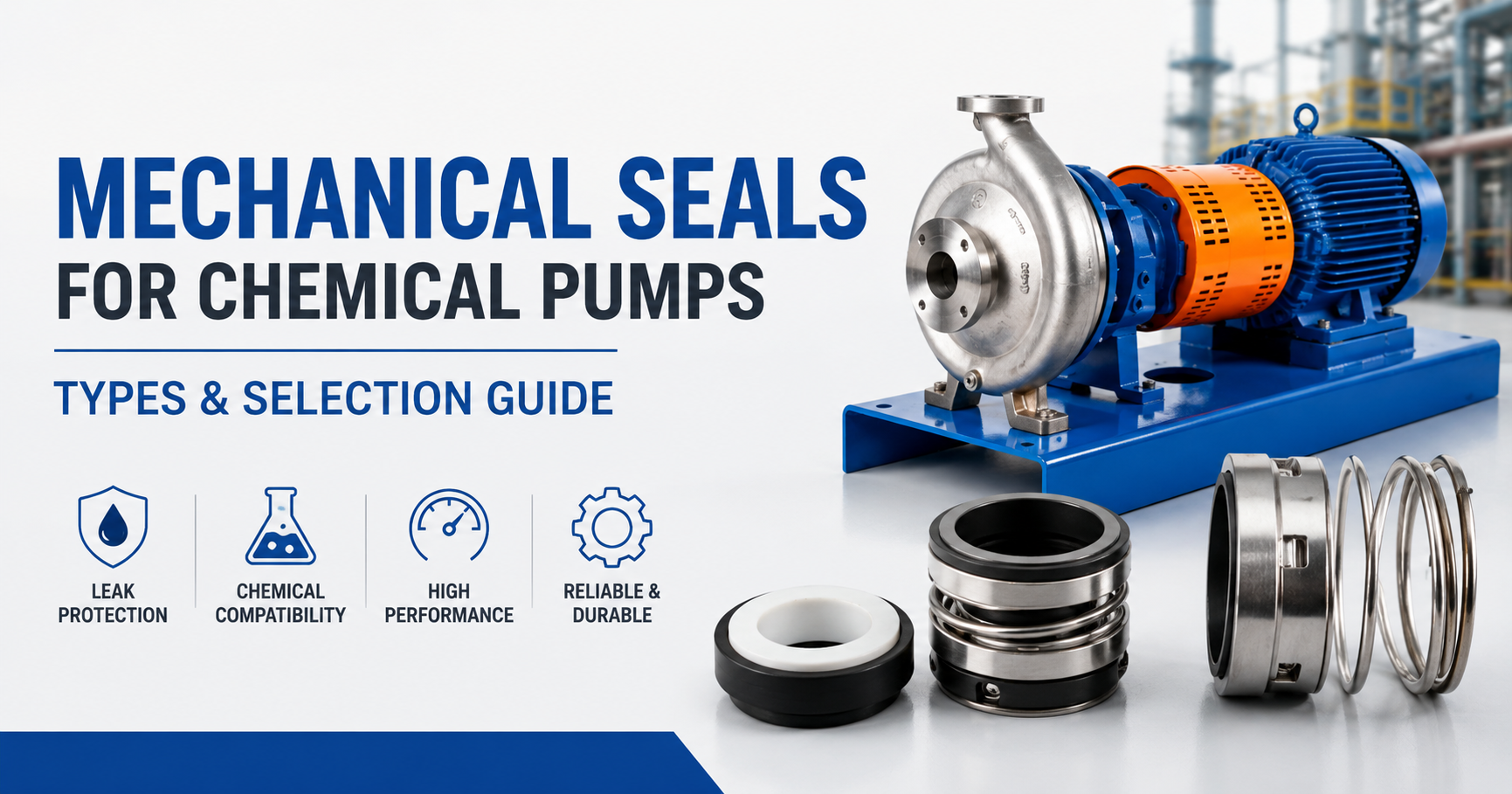
A mechanical seal is the component that prevents process fluid from leaking out along a pump’s rotating shaft, and on a chemical pump it’s usually the first part to fail, which makes seal selection arguably more important than pump selection itself once you’ve settled on a pump type. The right seal depends on the chemical being handled, its concentration and temperature, the system pressure, and whether any leakage at all is acceptable.
This guide covers how to think through that selection, then maps each seal category to specific options in Rotech’s seal range. For pump-level material selection, see our chemical pump materials guide.
The Four Questions That Determine Seal Selection
- What’s the chemical, and is it clean or abrasive? Clean, lubricating chemicals can use simpler seal designs. Abrasive or solids-bearing fluids need harder seal faces and often a clean flush.
- What’s the pressure? Higher system pressure generally requires a balanced seal design; unbalanced seals aren’t built to handle that face loading.
- Is any leakage acceptable? Hazardous, toxic, or strictly regulated chemicals typically call for a double (dual) seal arrangement rather than a single seal.
- Does the elastomer match the chemical? The seal faces matter, but a chemically incompatible elastomer (the secondary sealing material) is just as common a failure point.
Elastomer Compatibility at a Glance
Elastomer | Generally Good For | Generally Avoid With |
Viton (FKM) | Most oils, fuels, and a broad range of chemicals | Strong ketones, amines |
EPDM | Caustics, ketones, hot water/steam | Petroleum-based oils and fuels |
PTFE | Very broad chemical resistance, aggressive acids | Lower mechanical flexibility, higher cost |
This is a starting point, not a substitute for checking a chemical resistance chart against your exact chemical, concentration, and temperature.
Mechanical Seal Types for Chemical Service
Seal Category | How It Works | Best For | Rotech Options |
Single-spring elastomer bellows | A single spring maintains face contact; simple, cost-effective | General chemical transfer, moderate pressure | |
O-ring mounted | Spring-loaded face with an o-ring secondary seal | Clean to moderately abrasive chemicals | |
Balanced seals | Reduced face loading at the seal interface | Higher-pressure chemical service | |
PTFE wedge / non-pusher PTFE | PTFE faces resist a very broad range of chemicals | Highly aggressive or universally corrosive chemicals | |
Metal bellows | No elastomer secondary seal, better for high temperature and chemical compatibility | High-temperature chemical service, hot oil applications | |
Cartridge seals | Pre-assembled and pre-set, reducing installation error | Faster, more reliable installation on chemical pumps | |
Double / dual seals | Two seal faces with a barrier fluid between them | Toxic, hazardous, or zero-leakage-required chemicals | RS678 O-Ring Mounted Double Seal, RSCD2PR Dual Cartridge with Pumping Ring |
This isn’t the complete list; Rotech’s full mechanical seal catalog includes additional wave spring, multiple-spring, and metric seal options for less common configurations.
Flush Plans: Why a Seal’s Environment Matters as Much as the Seal Itself
Even the right seal design will fail prematurely in the wrong environment. Flush plans circulate clean, cool fluid around the seal faces to manage heat, flush away solids, and stabilize pressure, and the right plan depends on what’s actually threatening seal life in your application:
- Recirculation from the pump discharge back to the seal chamber is the simplest approach, suitable for clean chemicals without excessive heat generation.
- An external clean flush source is used when the process chemical itself is too abrasive, too hot, or chemically incompatible with the seal faces to use for flushing.
- A cyclone separator removes solids from a recirculated flush stream, useful for chemicals that carry some particulate without requiring a fully external clean source.
Rotech’s seal flush plan options cover these configurations; flush plan selection should happen alongside seal selection, not as an afterthought once the seal is already failing.
Troubleshooting Common Chemical Pump Seal Failures
- Seal leaking shortly after installation usually points to an installation error, incorrect spring compression, a damaged face during assembly, or a missed o-ring. Cartridge seals largely eliminate this failure mode since they arrive pre-set.
- Seal failing repeatedly at the same interval suggests an environmental issue rather than a defective part; check flush plan adequacy, fluid temperature, and whether the pump is being run off its best efficiency point.
- Visible elastomer swelling or cracking is a clear sign of chemical incompatibility with the secondary seal material; revisit the elastomer compatibility table above before replacing with the same part.
- Excessive heat at the seal chamber often means inadequate flushing or cooling for the duty cycle, not a seal design problem; adding or upgrading a flush plan is usually the fix before changing the seal type.
Supporting Components That Affect Seal Life
- Seal flush plans circulate clean fluid around the seal faces to manage heat, pressure, and contamination; see Rotech’s seal flush plan options.
- Bearing isolators keep contaminants out of the bearing housing, which indirectly extends seal life by keeping shaft runout and vibration in check; see bearing isolators.
How to Choose: A Step-by-Step Approach
- Start with the chemical and its concentration, and confirm elastomer and face material compatibility before anything else.
- Check your system pressure; if it’s elevated, narrow your options to balanced seal designs.
- Decide if any leakage is acceptable. If the chemical is toxic, flammable, or regulated, move to a double/dual seal rather than a single seal.
- Factor in temperature, especially for hot oil or steam-adjacent service; metal bellows designs generally outperform elastomer-based seals here.
- Weigh cartridge vs. component seals based on your maintenance team’s experience; cartridge seals reduce installation error at a higher upfront cost.
- Add a flush plan or bearing isolator if the application involves abrasives, high heat, or a history of premature seal failure on the existing pump.
Frequently Asked Questions
What’s the most common cause of mechanical seal failure on a chemical pump? Chemical incompatibility with the seal’s elastomer or face material is the most frequent cause, followed by running the pump far off its best efficiency point, which increases vibration and seal wear.
Do I need a double seal for every chemical pump? No, single seals are sufficient for most chemical transfer applications. Double/dual seals are reserved for toxic, flammable, or strictly regulated chemicals where any leakage is unacceptable.
What’s the difference between a balanced and unbalanced seal? A balanced seal design reduces the hydraulic load on the seal faces, making it suitable for higher-pressure service. Unbalanced seals are simpler and cheaper but limited to lower pressures.
Why use a cartridge seal instead of a component seal? Cartridge seals come pre-assembled and pre-set to the correct dimensions, which reduces the chance of an installation error, a meaningful advantage on chemical pumps where a seal failure means a chemical leak, not just downtime.
Does my chemical pump need a flush plan? If the chemical is clean and the duty isn’t demanding, simple recirculation from the pump discharge is often enough. Abrasive, hot, or chemically aggressive fluids typically need an external clean flush or cyclone separator to protect seal life; see the flush plan section above.
How long should a mechanical seal last on a chemical pump? It varies widely by chemical, pressure, and seal type, but a properly selected and flushed seal on a well-maintained pump commonly runs one to three years before a scheduled replacement, while a mismatched seal can fail within weeks. Repeated short-interval failures are a sign of an environmental or selection issue, not bad luck.
Not sure which seal fits your chemical and pressure conditions? Talk to Rotech’s engineering team or browse the full mechanical seal range.
Recent Posts
Centrifugal Pump Installation Guide: Step-by-Step Best Practices
A centrifugal pump installation has
Chemical Compatibility Guide: Pump Materials for Common Industrial Chemicals
Picking the wrong pump material
Chemical Pump Troubleshooting: Diagnosing Common Failures
Chemical pumps work hard. They