
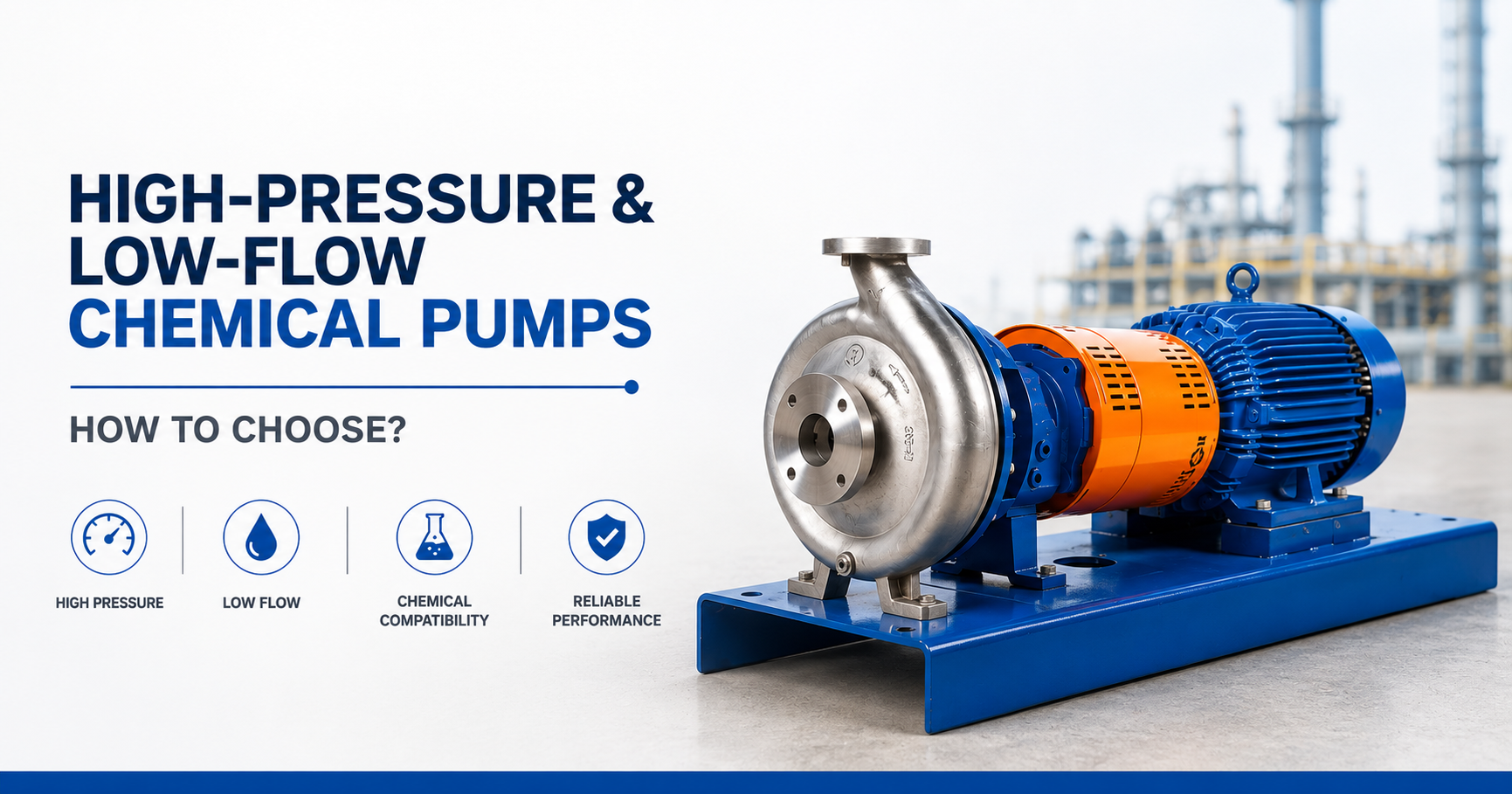
A high-pressure chemical pump is built to overcome significant resistance in a system, long pipelines, elevated discharge points, or injection into an already-pressurized process. In contrast, a low-flow chemical pump is built to deliver a small, steady volume with precision rather than speed. The two terms get used together because they’re often the same physical requirement: many high-pressure chemical applications, particularly metering and injection duty, also call for comparatively low flow.
Why Pressure and Flow Trade Off Against Each Other
For a centrifugal chemical pump, pressure (head) and flow sit on opposite ends of the same performance curve, for a given impeller and motor power, pushing more pressure typically means accepting less flow, and vice versa. It is the core reason “high pressure” and “low flow” chemical pumps are so often the same conversation: if your application genuinely needs both high pressure and high flow simultaneously, you’re usually looking at a larger motor, a multistage design, or a positive-displacement pump rather than a single-stage centrifugal.
How to Get High Pressure From a Chemical Pump
Approach | How It Works | Best For | Rotech Product |
Multistage centrifugal | Multiple impellers in series, each adding head | High pressure with moderate-to-high flow | |
Single-stage ANSI centrifugal, larger impeller | One impeller is sized for higher head | Moderate pressure increases without multistage complexity | |
Positive-displacement metering/injection | Mechanical displacement is largely independent of downstream pressure | High pressure at low, precise flow, chemical injection and dosing |
Positive-displacement designs are the standard choice when a chemical needs to be injected against real backpressure, a pipeline, a pressurized reactor, a wellhead, because their output flow doesn’t collapse the way a centrifugal pump’s does as system pressure rises. That’s why high-pressure chemical injection in oil and gas almost always uses metering-style positive-displacement pumps rather than centrifugal ones.
How to Get Low, Precise Flow From a Chemical Pump
- Use a low-flow ANSI pump if you’re staying centrifugal. Rotech’s 1196LF and 1296LF Series are purpose-built for chemical applications that need centrifugal reliability without high-volume output.
- Use a metering/dosing pump if precision matters more than raw flow. See our chemical feed pump guide for how positive-displacement metering pumps deliver accurate, repeatable low-flow dosing regardless of minor pressure fluctuations.
- Use a chemical injection pump if you’re dosing against backpressure. Our chemical injection pump guide covers selection for exactly this scenario.
- Don’t undersize a centrifugal pump to force low flow. Running a centrifugal pump far off its best efficiency point to artificially throttle flow causes premature wear and cavitation, if you need sustained low flow, choose a pump designed for it rather than throttling a larger one.
Seal and Material Considerations at High Pressure
High-pressure service puts more load on the mechanical seal than standard chemical transfer does, and seal selection needs to reflect that:
- Balanced seals are generally required at higher pressures, unbalanced seal designs aren’t built to handle the face loading that comes with elevated system pressure.
- Cartridge seals simplify installation and reduce the chance of an installation error becoming a high-pressure leak path.
- Browse Rotech’s mechanical seal range to find the right balanced or cartridge option once you’ve settled on pressure requirements.
Material selection doesn’t fundamentally change at high pressure, but the safety margin matters more, see our chemical pump materials table and our sulfuric acid material comparison for how concentration and temperature affect material limits under pressure.
High Pressure and Cavitation Risk
Pushing a centrifugal pump toward the high-pressure end of its curve also pushes it closer to its minimum continuous flow, and running below that threshold is one of the most common causes of premature failure on high-pressure chemical pumps, recirculation inside the casing generates heat and vibration that damages seals and bearings well before it shows up as an obvious problem. If a high-pressure chemical pump is failing repeatedly and the material and seal selection both check out, operating point relative to the pump curve is the next thing worth investigating, not the pump itself.
Net positive suction head (NPSH) also becomes tighter at higher discharge pressures in some system configurations, so it’s worth confirming available NPSH against the pump’s required NPSH at your actual operating point, not just at the pump’s rated duty point, before finalizing a high-pressure chemical pump selection.
Signs You’ve Mismatched Pump to Application
- Centrifugal pump losing prime or flow over time under what should be steady conditions often means the system’s actual head is higher than the pump curve was sized for.
- Inconsistent dosing accuracy from a pump expected to deliver low, precise flow usually points to a centrifugal pump being used where a metering pump was needed.
- Frequent seal failure on a high-pressure application often traces back to an unbalanced seal being used past its pressure rating rather than a chemical compatibility issue.
- Excessive noise or vibration at the discharge end can indicate the pump is being run too far off its best efficiency point to force a flow rate it wasn’t designed for.
Common Applications
- Pipeline corrosion inhibitor and scale inhibitor injection in oil and gas, almost always positive-displacement, often against several hundred PSI of backpressure.
- Boiler feedwater chemical treatment in power generation, where chemicals are dosed into an already-pressurized system.
- High-rise or long-distance chemical transfer, where elevation or pipeline length alone creates a high-head requirement even without injection into a pressurized process.
- Precise low-flow dosing in water treatment (chlorine, pH adjusters) and pharmaceutical manufacturing, where accuracy at low volume is the entire point.
Frequently Asked Questions
What’s considered a high-pressure chemical pump? There’s no single industry-wide PSI threshold, it’s relative to the application. The practical distinction is whether a standard single-stage centrifugal pump can meet your head requirement, or whether you need a multistage design or a positive-displacement pump to get there.
Why are high-pressure chemical pumps often low-flow? Because pressure and flow trade off against each other on a centrifugal pump curve, and because the applications that demand the highest pressures, injection against backpressure, precise dosing, typically don’t need high volume in the first place.
Should I use a centrifugal or positive-displacement pump for high-pressure chemical injection? Positive-displacement, in almost all cases. Its output flow stays consistent as downstream pressure rises, which is exactly what injection into a pressurized line or process requires.
Do high-pressure chemical pumps need a different seal? Yes, balanced mechanical seals are generally necessary at higher pressures, since unbalanced seal designs aren’t built for the increased face loading.
What if I need both high pressure and high flow at the same time? You’re likely outside what a single-stage centrifugal pump can deliver efficiently. A multistage centrifugal design, a larger motor and impeller combination, or in some cases parallel pumps are the usual paths forward, this is worth discussing directly with an engineer rather than guessing at sizing.
Does NPSH matter more for high-pressure chemical pumps? It matters at every pressure, but the margin for error often gets tighter as discharge pressure increases in certain system layouts. Confirm available NPSH against required NPSH at your actual operating point, not just the pump’s rated duty point.
Not sure whether your application needs multistage centrifugal or positive-displacement injection? Talk to Rotech’s engineering team or browse chemical injection pumps and vertical multistage pumps.
Recent Posts
Centrifugal Pump Installation Guide: Step-by-Step Best Practices
A centrifugal pump installation has
Chemical Compatibility Guide: Pump Materials for Common Industrial Chemicals
Picking the wrong pump material
Chemical Pump Troubleshooting: Diagnosing Common Failures
Chemical pumps work hard. They