
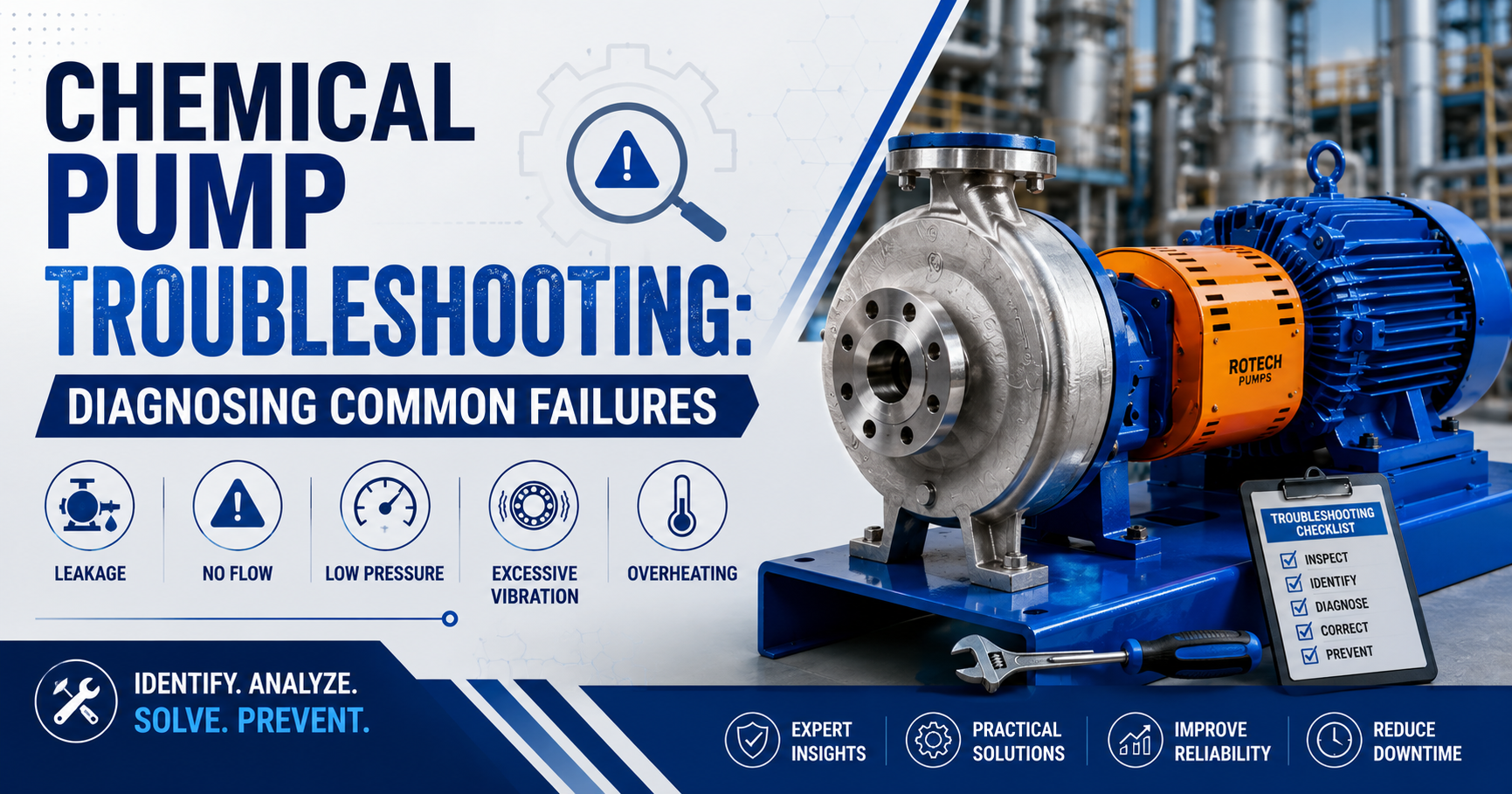
Chemical pumps work hard. They move acids, caustics, solvents, and process chemicals day in and day out, often in harsh conditions. So when something goes wrong, it can stop production fast and create a serious safety risk.
The good news is that most chemical pump failures follow a pattern. The pump gives you warning signs before it completely breaks down. You just need to know what to look for.
This guide covers the seven most common chemical pump problems, their root causes, and the right fix for each one. Whether your pump is losing prime, running too hot, vibrating, leaking at the seal, or not delivering enough flow, this troubleshooting guide will help you get to the bottom of it quickly.
Why Chemical Pump Failures Are Different From Regular Pump Failures
Troubleshooting a chemical pump is not the same as fixing a water pump. The aggressive nature of the fluids adds complexity you don’t face with clean water.
Chemical compatibility plays a role in almost every failure mode. A seal that works perfectly for water can degrade in weeks when exposed to the wrong acid or solvent. A casing that handles mild fluids without issue can corrode rapidly when chemical concentration shifts.
According to the Hydraulic Institute, pump failures in chemical and process industries account for a significant share of unplanned plant shutdowns. Most failures trace back to three root causes: wrong pump selection, inadequate maintenance, and seal or material incompatibility.
Before you start checking individual components, make sure the pump was the right choice for the application. Our guide on how to select the right pump covers the selection criteria in detail.
The 7 Most Common Chemical Pump Problems
1. Pump Not Priming or Losing Prime
What you notice: The pump runs but no fluid comes out, or it delivers flow briefly and then loses it.
Why it happens:
- Air trapped in the suction line or pump casing
- Suction lift is too high for the pump design
- The suction pipe has a leak pulling air into the system
- The foot valve or check valve is worn or stuck open
- Impeller is partially blocked
A standard centrifugal chemical pump needs a flooded suction to work properly. If the fluid level drops below the suction inlet, the pump loses prime and runs dry. Even brief dry running can damage the seal and impeller.
If your application regularly runs with a low or inconsistent suction head, a self-priming design is often the better solution. The SCP/SFP self-priming centrifugal pumps are built for drum, tote, and tank transfer where suction conditions are unpredictable.
The fix: Check the suction line for air leaks and blockages. Confirm the static suction lift is within the pump’s rated limit. Replace a worn foot valve if it is not holding. If priming problems are chronic, consider a self-priming pump design.
2. Low Flow Rate or No Flow
What you notice: The pump runs but delivers less flow than expected, or stops delivering altogether.
Why it happens:
- Impeller wear or corrosion has reduced its effective diameter
- Increased system resistance from a partially closed valve or blocked pipe
- The pump is operating far right on its curve, beyond rated flow
- Air pockets in the suction line
- Worn wear rings increasing internal recirculation
The pump curve is your most useful diagnostic tool here. If your current operating point sits far to the right of the best efficiency point, system resistance has likely changed, not the pump. Our post on pump curves for centrifugal pumps explains how to read the curve and locate where your pump is actually running.
The fix: Check all valves and confirm none are partially closed. Inspect the impeller for wear or chemical attack. If the impeller shows significant material loss, replace it with one rated for your specific chemical.
3. Seal Leakage
What you notice: Fluid dripping or spraying from around the pump shaft area. With chemical pumps, even a small seal leak can be a safety hazard.
Why it happens:
- Chemical incompatibility between the fluid and the seal elastomer
- Incorrect seal installation or wrong compression setting
- Pump running dry, which overheats and damages the seal faces
- Operating pressure higher than the seal’s rated limit
- Shaft misalignment causing uneven face loading
Seal failure is the leading cause of chemical pump downtime. The U.S. Department of Energy notes that mechanical seals are among the most maintenance-intensive components in industrial pumping systems. The problem is almost always one of two things: the wrong seal was chosen, or the operating conditions changed after installation.
The seal elastomer must be compatible with the specific chemical, at the actual concentration and temperature your system runs. A Viton (FKM) seal handles most oils and chemicals but fails rapidly in certain ketones or amines. EPDM works with caustics but degrades in petroleum-based fluids. PTFE offers the broadest chemical resistance but has mechanical limitations at higher pressures.
If your pump operates at elevated pressure, an unbalanced seal may be the wrong choice. Balanced seals reduce the hydraulic load on seal faces and are designed for higher-pressure chemical service. For systems where any leakage is unacceptable, a dual cartridge seal with barrier fluid provides a true zero-leakage arrangement.
The fix: Identify the exact chemical, concentration, and temperature, then cross-check those against your current seal’s elastomer compatibility data. If the seal is correctly specified but still failing, check shaft alignment and confirm the pump is not running dry. Browse the full mechanical seal range to find a rated replacement.
4. Excessive Noise and Vibration
What you notice: The pump is louder than normal, produces a rattling or grinding sound, or vibrates noticeably during operation.
Why it happens:
- Cavitation inside the pump casing
- Shaft misalignment between the pump and motor
- Worn or damaged bearings
- Loose baseframe or coupling
- Foreign material caught in the impeller
Vibration and noise are almost always the pump telling you something is wrong before a harder failure follows. Ignoring unusual pump noise is one of the most common pumping mistakes in process plants.
Misalignment is a frequent culprit, particularly after maintenance. Even small shaft misalignment puts uneven load on the bearings and seal, accelerating wear across multiple components. Bearing isolators protect the bearing housing from contamination but cannot fix an alignment problem.
The fix: Check shaft alignment first, especially if noise started after maintenance. Inspect the coupling for wear. Check the base frame and coupling assembly for loose bolts. If the noise has a rhythmic pulsing quality, cavitation is the more likely cause.
5. Cavitation
What you notice: A crackling or rattling noise from inside the pump casing, often described as pumping gravel. Flow becomes unstable. The pump vibrates and overheats.
Why it happens:
- Available net positive suction head (NPSH) is lower than the pump’s required NPSH
- Suction pipe is too small or too long
- Fluid temperature is too high, causing vapour formation
- Pump is running beyond its rated flow rate
Cavitation forms when the pressure at the impeller eye drops below the vapour pressure of the liquid, causing vapour bubbles to form and then collapse violently against the impeller surface. Over time, this erodes the impeller and casing and is one of the most destructive failure modes in chemical pump operation.
Our detailed guide on how to prevent cavitation in centrifugal pumps covers the mechanics, and our post on understanding NPSH and cavitation prevention explains how to calculate whether your system has enough suction head.
The fix: Calculate available NPSH and compare it against the pump’s required NPSH at the actual operating point. If available NPSH is too low, increase the suction pipe diameter, shorten the suction pipe, or raise the fluid level. Do not simply throttle the discharge valve without understanding where that moves the operating point.
6. Overheating
What you notice: The pump casing or bearing housing is hot to the touch. Thermal protection trips the motor. The seal begins to leak after running.
Why it happens:
- Pump running at very low or zero flow (minimum flow not maintained)
- Inadequate or failed seal flush
- Bearing lubrication breakdown
- Ambient temperature higher than the pump was rated for
- The fluid itself is operating near or above its rated temperature limit
When a centrifugal pump runs at very low flow, the energy it puts into the fluid has nowhere to go, so it turns into heat inside the casing. For chemical pumps handling fluids close to their boiling point, even a small temperature rise causes problems quickly.
A failed seal flush is another common cause. The flush circulates fluid around the seal faces to cool them and carry away heat. Without it, seal face temperatures rise and the faces can crack or warp. Rotech’s seal flush plans provide the right circulation arrangement for different chemical and pressure conditions.
The fix: Confirm the pump is not running below minimum continuous flow. Check that the seal flush is active. Verify bearing lubrication levels. If fluid temperature has increased since original installation, check whether pump materials and seal are still rated for the new conditions.
7. Premature Bearing Failure
What you notice: Loud rumbling from the bearing housing. Increased vibration. Bearing housing running hot. Bearings need replacement far more often than expected.
Why it happens:
- Contamination of the bearing housing with process fluid or moisture
- Over or under lubrication
- Shaft misalignment putting radial and axial loads beyond bearing design limits
- Pump running far from best efficiency point, increasing bearing loads
- Wrong bearing specification for the operating temperature
Bearings in chemical pump applications face contamination risks that do not exist in clean-fluid systems. If a seal starts weeping, process chemical can migrate into the bearing housing and attack the lubrication or the bearing material directly. This is why bearing isolators are standard on serious chemical pump installations. They prevent both process fluid ingress and external moisture contamination.
The fix: Install bearing isolators if they are not already fitted. Check and correct shaft alignment. Verify lubrication type and quantity against the manufacturer’s specification. If bearing failures recur on a correctly aligned pump, review whether the pump is running near its best efficiency point.
Quick-Reference Troubleshooting Table
| Symptom | Most Likely Cause | First Check |
|---|---|---|
| No prime | Air in suction line, high suction lift | Suction pipe for leaks, foot valve condition |
| Low flow | Worn impeller, increased system resistance, partially closed valve | All valves open, impeller condition |
| Seal leaking | Material incompatibility, dry running, wrong seal type | Elastomer vs. chemical compatibility data |
| Noise and vibration | Misalignment, cavitation, worn bearings | Shaft alignment, coupling condition |
| Cavitation (gravel sound) | Insufficient NPSH, pump running past rated flow | Available vs. required NPSH |
| Overheating | Low flow operation, failed seal flush | Minimum flow maintained, flush flow active |
| Frequent bearing failure | Contamination, misalignment, wrong lubricant | Bearing isolators fitted, alignment correct |
The Relationship Between Maintenance and Troubleshooting
Troubleshooting and maintenance are two sides of the same coin. Good preventive maintenance reduces how often you need to troubleshoot. Poor maintenance turns small issues into urgent failures.
If you find yourself troubleshooting the same pump repeatedly, it usually means one of three things: the pump was not the right selection for the duty, the maintenance schedule is not adequate, or the operating conditions have changed since installation.
Our chemical pump maintenance tips guide covers a full preventive schedule, and our centrifugal pump maintenance checklist gives you a structured reference for regular inspection tasks. OSHA’s process safety management guidelines also recommend documented mechanical integrity programs for pumps handling hazardous chemicals. A written maintenance log makes troubleshooting much faster next time.
When Troubleshooting Is Not Enough
Sometimes the pump is not the problem. The system around it has changed in a way that makes the original pump wrong for the current job.
Watch for these signals:
- You have rebuilt or replaced the same component three or more times in 12 months
- The chemical concentration or temperature has changed since original installation
- Flow requirements have increased beyond the pump’s rated capacity
- The pump consistently runs far from its best efficiency point
If any of these apply, a pump selection review is more useful than another repair. Our guide on factors that affect centrifugal pump efficiency can help identify whether the operating conditions are the real issue. For corrosive applications, material suitability may also need a full review. See our acid pumps guide and chemical pump overview for selection frameworks.
Frequently Asked Questions
What is the most common cause of chemical pump failure?
Mechanical seal failure is the most frequent cause of unplanned chemical pump downtime. It usually traces to chemical incompatibility between the fluid and the seal elastomer, running the pump dry, or operating at pressures beyond the seal’s rating.
How do I know if my chemical pump is cavitating?
Cavitation sounds like the pump is moving gravel or small stones. It comes with unstable flow, increased vibration, and rising pump temperature. Stop the pump and check your available NPSH against the pump’s required NPSH before restarting.
Why does my chemical pump keep losing prime?
The most common reasons are air entering the suction line through a leak, a suction lift that is too high for the pump design, or a worn foot valve that cannot hold fluid when the pump stops. A self-priming pump design eliminates most of these issues for drum and tote transfer applications.
What does pump vibration indicate?
Vibration most often points to shaft misalignment, cavitation, worn bearings, or loose mechanical connections. Misalignment is the most common and the easiest to fix. Cavitation vibration has a distinctive rattling sound and is usually accompanied by unstable flow.
Summary
Chemical pump troubleshooting follows a logical process. Start with the symptom, identify the most likely root cause, and confirm your diagnosis before replacing parts. Replacing components without a confirmed diagnosis is how a simple seal leak becomes an expensive pump rebuild.
The seven failure modes in this guide cover the majority of what you will encounter in real chemical pump applications. Most connect back to one of three root causes: wrong material selection, operating the pump outside its rated conditions, or inadequate maintenance.
At Rotech Pumps, our engineering team helps plants across the USA and Canada diagnose chemical pump problems and select the right replacement components, from mechanical seals and seal flush plans to complete chemical process pump systems. If you have a pump that is not performing as expected, contact our team or submit a pump inquiry and we will help you get to the bottom of it.
Recent Posts

What Is a Chemical Metering Pump? Types, How They Work, and How to Size One
A chemical metering pump is
Centrifugal Pump Installation Guide: Step-by-Step Best Practices
A centrifugal pump installation has
Chemical Compatibility Guide: Pump Materials for Common Industrial Chemicals
Picking the wrong pump material