
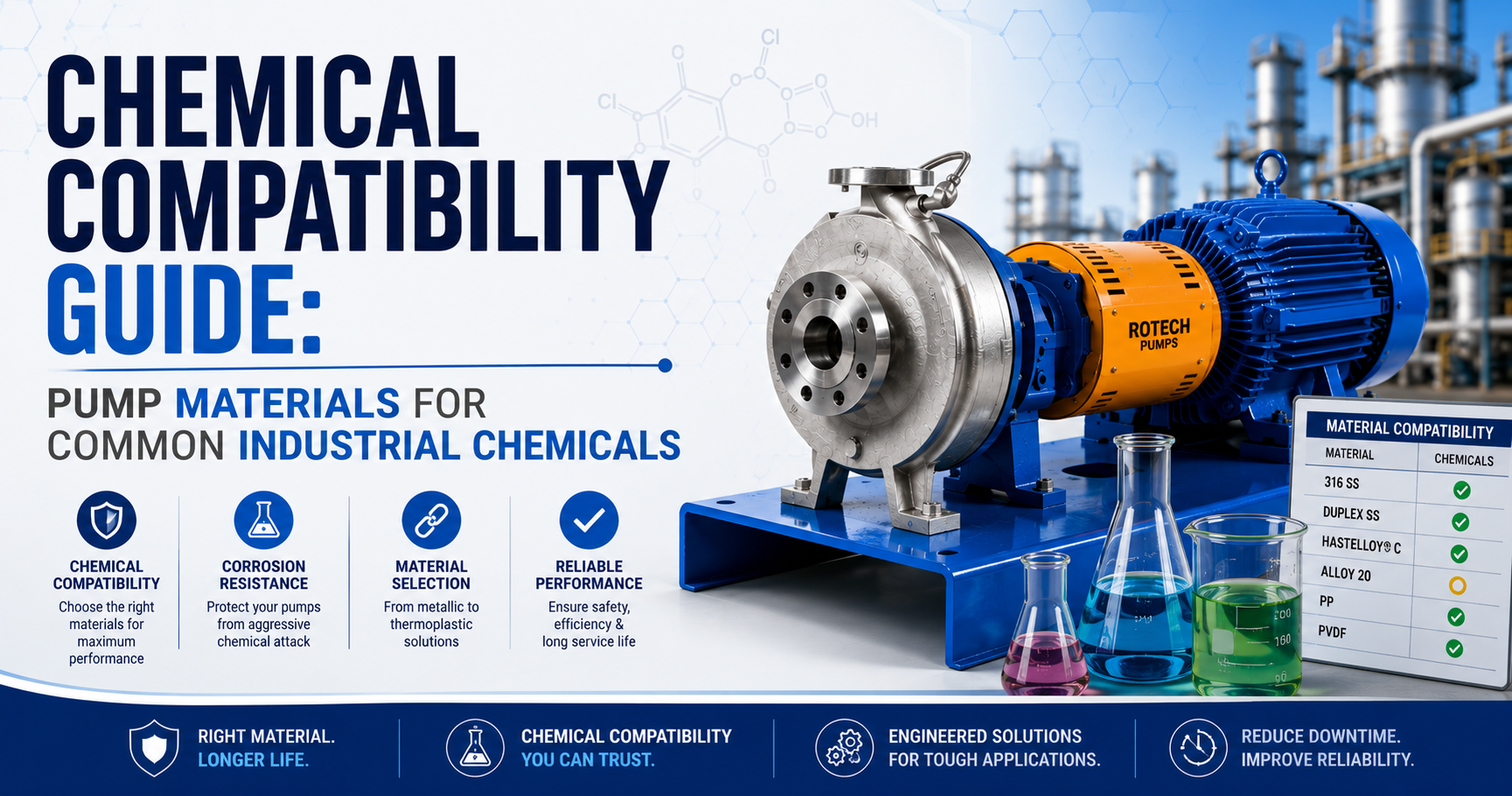
Picking the wrong pump material is the fastest way to destroy a chemical pump. The wrong casing corrodes. The wrong impeller dissolves. The wrong seal swells, cracks, or melts. And when that happens in a system moving acids, caustics, or solvents, you are not just looking at a pump failure. You are looking at a production shutdown, a chemical spill, and a potential safety incident.
This guide cuts through the confusion. It covers the most common pump materials used in industrial chemical service, explains what each one handles and what it does not, and then maps ten of the most frequently pumped industrial chemicals to the right material, elastomer, and seal type. Whether you are specifying a new pump or troubleshooting a material failure on an existing one, this guide gives you a reliable starting point.
For background on how chemical pumps work and which pump types are available, see our complete guide to chemical pumps.
Why Material Selection Is the Leading Cause of Chemical Pump Failure
Most pump engineers know that material compatibility matters. But in practice, the decision often gets made quickly, based on what’s familiar or what’s in stock. A 316 stainless steel pump gets ordered because that’s what was used last time, without checking whether the new chemical runs at a higher concentration or temperature that pushes stainless outside its safe range.
According to the Hydraulic Institute, corrosion-related failures account for a significant portion of premature pump replacements in chemical process industries. The failure mechanism varies. Sometimes the casing wall thins slowly over months and then fractures under pressure. Sometimes the impeller loses metal mass, throws the pump out of balance, and destroys the bearings before anyone notices the corrosion. Sometimes the elastomer in the seal swells from chemical exposure, loses its sealing ability, and causes a slow leak that eventually becomes a major one.
All of these are preventable with the right material selection at the start.
The U.S. Environmental Protection Agency identifies material incompatibility as a contributing factor in many chemical release incidents at industrial facilities. Correct material selection is not just an engineering preference. It is a safety requirement.
The Four Variables That Affect Material Compatibility
Before you look at any compatibility table, you need to know four things about your application. Changing any one of them can shift the right material choice.
1. Chemical identity and concentration
Sulfuric acid at 10% concentration and sulfuric acid at 98% concentration behave very differently toward the same metal. Some materials that resist dilute acids fail rapidly in concentrated versions, and some materials perform better in concentrated acid than in dilute. Always identify both the chemical and its concentration before checking compatibility.
2. Operating temperature
Most compatibility data is published at room temperature (around 20°C or 68°F). As temperature rises, corrosion rates accelerate and some materials cross from safe to unsafe. A pump material rated for a chemical at 20°C may not be suitable at 60°C or 80°C. Check the compatibility data at your actual operating temperature, not at room temperature.
3. System pressure
Higher pressure does not change corrosion chemistry, but it does affect the consequences of material failure. A casing that is slowly thinning from corrosion will hold longer at low pressure than under elevated system pressure. For high-pressure chemical applications, material safety margins need to be wider.
4. Fluid velocity and abrasion
Fast-moving corrosive fluid erodes materials more quickly than slow-moving fluid at the same concentration and temperature. Impeller passages and casing volutes, where velocities are highest, are the first places corrosion shows up on a pump running near or beyond its rated capacity.
Common Pump Materials: What They Handle and What They Don’t
| Material | Chemical Resistance Strengths | Avoid With | Typical Application |
|---|---|---|---|
| 316 Stainless Steel | General industrial acids at moderate concentration, caustics, most organic chemicals | High-chloride environments, concentrated HCl, seawater, ferric chloride | Default starting point for most chemical service |
| Alloy 20 | Sulfuric acid across a wide concentration range, phosphoric acid, mixed acid service | Strong oxidizers, high-temperature HCl | Sulfuric acid transfer and process duty |
| Hastelloy C-276 | Highly oxidizing acids, chloride-bearing chemicals, seawater, mixed acid service | Very few exceptions — one of the broadest chemical resistances available in metallic materials | The most demanding corrosive chemical service |
| CD4MCu (Duplex Stainless) | Chloride-bearing fluids, sulfuric and phosphoric acid, seawater | Very strong oxidizing acids, very high temperatures | Marine, desalination, and phosphoric acid duty |
| PVDF (Kynar) | Aggressive acids, halogens, sodium hypochlorite, solvents | High-temperature service above 140°C, strong bases at elevated temperature | Chemical dosing, water treatment, acid transfer at moderate pressure |
| Polypropylene (PP) | Dilute acids, caustics, salt solutions | Aromatic and chlorinated solvents, temperatures above 80°C | Low-pressure, low-temperature chemical service |
| Cast Iron / Ductile Iron | Water, non-corrosive fluids, some neutral pH processes | Any acid, caustic, or corrosive chemical — corrodes rapidly | Not for chemical service |
| Bronze / Brass | Some fresh water applications | Ammonia and ammonium compounds, many acids and caustics, any chloride-heavy fluid | Limited to specific mild-fluid applications |
This table gives you a starting framework. The sections below go chemical by chemical and give more specific guidance on where these materials succeed, where they fall short, and what seal materials to pair with each one.
Chemical-by-Chemical Compatibility Guide
Sulfuric Acid (H₂SO₄)
Sulfuric acid is one of the most widely pumped industrial chemicals and one of the most material-sensitive. Its corrosivity toward metals changes dramatically with concentration.
Low to medium concentration (up to 65%): Highly corrosive to most metals. 316 stainless steel performs poorly across this range. Alloy 20 is the standard choice, with Hastelloy C-276 reserved for the most demanding conditions or mixed acid service.
High concentration (above 80–85%): A passivation layer forms on some metals, making materials like cast iron and even some grades of steel surprisingly resistant at high concentration and ambient temperature. However, this passivation breaks down rapidly if the concentration drops, the temperature rises, or the flow velocity increases. For a predictable, reliable installation, Alloy 20 or Hastelloy C-276 remains the safer choice across all concentrations.
Seal elastomer: PTFE or PTFE-encapsulated elastomers are the standard. Viton (FKM) is compatible at moderate concentration and temperature but may not be suitable at high temperature or very high concentration. EPDM is not suitable for sulfuric acid.
We have covered sulfuric acid material selection in dedicated depth in our Alloy 20 vs. Hastelloy C vs. PVDF comparison and our battery acid and sulfuric acid transfer guide. If sulfuric acid is your primary concern, start with those two resources.
Hydrochloric Acid (HCl)
Hydrochloric acid is one of the most aggressive industrial chemicals and it is corrosive toward nearly all metals, including most grades of stainless steel. Chloride ions attack the passive film on stainless steel, causing pitting and stress corrosion cracking.
Recommended materials: PVDF and other fluoropolymers are the standard choice for HCl service. Hastelloy C-276 offers the best metallic resistance but comes at a significant cost premium. For pumps that only contact dilute HCl at ambient temperature and low pressure, polypropylene or PVDF-lined designs are often the more cost-effective solution.
Materials to avoid: 316 stainless steel, cast iron, and bronze all corrode rapidly in HCl service regardless of concentration. Even Alloy 20, which handles sulfuric acid well, is not the right choice for hydrochloric acid at elevated temperatures or concentrations above about 5%.
Seal elastomer: PTFE is the standard. Viton (FKM) is generally resistant to dilute HCl at ambient temperature but should be verified against your specific concentration and temperature conditions. EPDM is not suitable.
Caustic Soda / Sodium Hydroxide (NaOH)
Caustic soda is highly alkaline rather than acidic, which shifts the material selection completely. Many metals that struggle with acids perform well in caustic service, and some that handle acids poorly are actually appropriate here.
Recommended materials: 316 stainless steel handles caustic soda well across a wide range of concentrations and temperatures. Cast iron is also commonly used in caustic service at moderate concentration and temperature, particularly in water treatment. PVDF is resistant to caustic at moderate temperatures.
Materials to avoid: Aluminium corrodes rapidly in caustic. Certain grades of glass-filled PTFE can be attacked by concentrated caustic at elevated temperature. Zinc-based alloys are not suitable.
Watch out for stress corrosion cracking: Concentrated caustic soda at elevated temperatures can cause stress corrosion cracking in stainless steel. For hot, concentrated caustic service, verify the specific grade of stainless steel against your temperature and concentration conditions.
Seal elastomer: EPDM is the standard choice for caustic service. Viton is not suitable for caustic soda. Buna-N (Nitrile) performs poorly in caustic at elevated temperatures.
Sodium Hypochlorite (Bleach / NaOCl)
Sodium hypochlorite is widely used in water treatment, food processing, and industrial cleaning. It is oxidising and chloride-bearing, which makes it aggressive toward metallic pump components.
Recommended materials: PVDF and other fluoropolymers handle sodium hypochlorite well across the concentration range used in industrial applications. Hastelloy C-276 offers the best metallic resistance for higher concentrations or elevated temperatures. 316 stainless steel is marginal — it may be acceptable for dilute concentrations at ambient temperature but should not be used as the default choice.
Materials to avoid: Cast iron, bronze, and most carbon steels. The combination of oxidising chemistry and chloride ions attacks these materials rapidly. Polypropylene can be acceptable for very dilute concentrations but degrades in more concentrated bleach solutions.
Seal elastomer: EPDM handles sodium hypochlorite well. Viton is generally resistant to dilute concentrations but may degrade in concentrated hypochlorite service. PTFE provides the broadest resistance across concentrations.
Nitric Acid (HNO₃)
Nitric acid is a strong oxidising acid, and this oxidising character makes it behave differently from most other acids in pump material selection.
Recommended materials: 316 stainless steel is actually the standard choice for nitric acid in the medium concentration range (up to around 65%). The oxidising nature of nitric acid maintains the passive film on stainless steel rather than attacking it the way reducing acids do. For higher concentrations or temperatures, Hastelloy C-276 is the appropriate step up.
Materials to avoid: Hastelloy B and carbon steel are not suitable for nitric acid service. Alloy 20, which is excellent for sulfuric acid, is not the right choice for nitric acid. Copper-based alloys corrode rapidly in nitric acid.
Seal elastomer: PTFE is the standard choice. Viton is not suitable for concentrated nitric acid at elevated temperatures. Buna-N and EPDM are not suitable.
Phosphoric Acid (H₃PO₄)
Phosphoric acid is used in fertiliser production, food and beverage processing, and metal surface treatment. It is a moderately corrosive acid that is generally less aggressive than sulfuric or hydrochloric acid.
Recommended materials: Alloy 20 is the standard for phosphoric acid service in fertiliser and chemical applications. 316 stainless steel handles dilute phosphoric acid at ambient temperature but may not be suitable at elevated temperatures or higher concentrations. CD4MCu duplex stainless offers good performance in food-grade phosphoric acid service.
Materials to avoid: Cast iron corrodes in phosphoric acid. Bronze and copper-based alloys are unsuitable. For high-purity applications in food and pharmaceutical production, verify that the pump material is also compliant with food contact material regulations.
Seal elastomer: Viton (FKM) is the standard choice for phosphoric acid. EPDM is suitable for food-grade phosphoric acid at moderate temperature. PTFE provides the broadest coverage across concentrations.
Acetic Acid (CH₃COOH)
Acetic acid is present across the chemical, food, pharmaceutical, and textile industries. Glacial (pure) acetic acid and dilute acetic acid at elevated temperature require careful material selection.
Recommended materials: 316 stainless steel handles dilute acetic acid well at ambient temperature. For higher concentrations or temperatures, Hastelloy C-276 or glass-reinforced PVDF provides better resistance. In food-grade applications, the pump materials must also comply with applicable food contact standards.
Materials to avoid: Cast iron and carbon steel corrode in acetic acid. Copper-based alloys (bronze, brass) are not suitable and can contaminate the product. Some elastomers, including Buna-N, do not resist acetic acid at elevated temperature.
Seal elastomer: PTFE is the most broadly suitable choice. Viton handles dilute concentrations at moderate temperature. EPDM should be checked against your specific concentration and temperature.
Ammonia / Ammonium Hydroxide (NH₃ / NH₄OH)
Ammonia and ammonium compounds are used in fertiliser production, refrigeration, water treatment, and pharmaceutical manufacturing. They are strongly alkaline and incompatible with copper-based alloys.
Recommended materials: 316 stainless steel is the standard choice for ammonia and ammonium hydroxide service. Cast iron is used in some refrigeration applications. PVDF handles ammonium hydroxide at moderate concentration.
Materials to avoid: Copper, brass, bronze, and any copper-bearing alloy must never be used with ammonia — the reaction forms copper-amine complexes that corrode the metal rapidly and contaminate the fluid. This is one of the clearest material restrictions in industrial pump selection.
Seal elastomer: EPDM is the standard choice for ammonia service. Buna-N (Nitrile) is not suitable. Viton compatibility should be checked against your specific concentration and temperature.
Hydrogen Peroxide (H₂O₂)
Hydrogen peroxide is a powerful oxidiser used in bleaching, sterilisation, and chemical synthesis. It decomposes in contact with catalytic materials, releasing oxygen rapidly. Even trace contamination from the wrong material can trigger runaway decomposition.
Recommended materials: 316 stainless steel handles low-concentration hydrogen peroxide (up to around 30%) at ambient temperature. For higher concentrations, PVDF or other fluoropolymers are the preferred choice. The pump must be scrupulously clean before first use — any organic contamination or metallic catalyst residue can trigger decomposition.
Materials to avoid: Cast iron, copper, and bronze catalyse decomposition of hydrogen peroxide rapidly and must never be used. Elastomers should be verified for oxidative stability at your concentration. Buna-N is generally not suitable.
Seal elastomer: EPDM handles hydrogen peroxide service well across a range of concentrations. PTFE is the broadest-coverage choice for high concentrations. Viton should be verified at your specific conditions.
Ferric Chloride (FeCl₃)
Ferric chloride is used in printed circuit board etching, water treatment, and metal surface treatment. It is both acidic and extremely high in chloride content, making it one of the most aggressive liquids for metallic pump materials.
Recommended materials: PVDF and other fluoropolymers are the standard choice. Hastelloy C-276 is the best metallic option, though its cost makes polymer-lined or non-metallic pump designs more common in ferric chloride service. Rubber-lined centrifugal pumps are also used in certain water treatment applications.
Materials to avoid: 316 stainless steel, carbon steel, cast iron, aluminium, and copper-based alloys all corrode rapidly in ferric chloride. The combination of strong acidity and very high chloride ion concentration attacks standard stainless steel aggressively.
Seal elastomer: PTFE is the standard choice. Viton compatibility should be checked against your specific concentration and temperature. EPDM is generally not suitable for ferric chloride service.
Summary Compatibility Table
This table is a quick-reference guide. Always verify against your actual chemical, concentration, temperature, and pressure before finalising a selection.
| Chemical | Preferred Pump Material | Acceptable Alternative | Avoid | Seal Elastomer |
|---|---|---|---|---|
| Sulfuric Acid (dilute) | Alloy 20 | Hastelloy C-276 | 316SS, Cast Iron | PTFE |
| Sulfuric Acid (concentrated) | Alloy 20 | Hastelloy C-276 | Cast Iron, Bronze | PTFE |
| Hydrochloric Acid | PVDF / Hastelloy C-276 | PP (dilute, low temp) | 316SS, Alloy 20, Cast Iron | PTFE |
| Caustic Soda (NaOH) | 316 Stainless Steel | Cast Iron (moderate conc.) | Aluminium, Zinc alloys | EPDM |
| Sodium Hypochlorite | PVDF / Hastelloy C-276 | 316SS (dilute only) | Cast Iron, Bronze, Carbon Steel | EPDM / PTFE |
| Nitric Acid | 316 Stainless Steel | Hastelloy C-276 (high conc.) | Alloy 20, Carbon Steel, Copper | PTFE |
| Phosphoric Acid | Alloy 20 | 316SS (dilute, ambient temp) | Cast Iron, Copper alloys | Viton |
| Acetic Acid | 316SS / Hastelloy C-276 | PVDF (high conc.) | Cast Iron, Copper alloys | PTFE |
| Ammonia / Ammonium Hydroxide | 316 Stainless Steel | PVDF | Copper, Brass, Bronze | EPDM |
| Hydrogen Peroxide | PVDF (high conc.) | 316SS (dilute, ambient) | Cast Iron, Copper, Bronze | EPDM / PTFE |
| Ferric Chloride | PVDF / Hastelloy C-276 | Rubber-lined | 316SS, Cast Iron, Aluminium | PTFE |
Seal Material Compatibility — The Part That Gets Overlooked
Most engineers focus on the pump casing and impeller material and treat the seal as an afterthought. But a chemically incompatible seal elastomer fails just as fast as a corroded casing, and the failure mode is more immediately dangerous because it opens a direct leak path.
The secondary sealing element in a mechanical seal — the o-ring, bellows, or wedge that seals around the stationary faces — must be compatible with the process chemical, just like the wetted metal components.
| Elastomer | Chemical Strengths | Do Not Use With |
|---|---|---|
| Viton (FKM) | Oils, fuels, most acids at moderate concentration and temperature, many solvents | Strong caustics (NaOH), amines, ketones like acetone, MEK |
| EPDM | Caustics, ammonia, steam, hot water, ketones, many water treatment chemicals | Petroleum-based oils and fuels, aromatic solvents |
| PTFE / Encapsulated PTFE | The broadest chemical resistance of any common elastomer — suitable for most acids, caustics, and solvents | Molten alkali metals, fluorine gas — essentially nothing in common industrial service |
| Buna-N (Nitrile) | Petroleum oils and fuels, mild water service | Acids, caustics, ammonia, ozone, strong oxidisers |
| FFKM (Perfluoroelastomer) | Essentially universal chemical resistance, rated for extreme temperatures | Cost — typically reserved for the most demanding or high-value process applications |
For applications where the chemical is aggressive enough that even PTFE-lined faces and elastomers may not be enough, a double seal with a chemically compatible barrier fluid eliminates the process fluid from contacting the seal faces entirely. For that arrangement, the dual cartridge seal with pumping ring is designed specifically for zero-leakage chemical service.
Browse Rotech’s full mechanical seal range for specific seal models across elastomer and PTFE categories, including PTFE bellow seals, PTFE wedge seals, and balanced seals for higher-pressure chemical service.
When Standard Materials Are Not Enough: Lined and Sealless Options
Some chemicals are aggressive enough that no standard metallic pump material provides long-term reliable service at an acceptable cost. In those cases, two design approaches provide the next level of protection.
Polymer-lined metallic pumps use a standard metallic pump body with a moulded PVDF, polypropylene, or rubber lining covering all wetted surfaces. The metal outer casing provides structural strength while the lining provides chemical resistance. This approach is common in highly aggressive acid service, particularly for HCl and ferric chloride.
Sealless / magnetic-drive pumps eliminate the mechanical seal entirely by using a magnetic coupling to drive the impeller from outside a sealed containment shell. With no shaft penetrating the casing, there is no seal to leak. This is the right choice for toxic, highly volatile, or strictly regulated chemicals where even the smallest leakage is unacceptable.
For applications moving corrosive chemicals with precision dosing requirements, the chemical injection pump range and chemical feed pump options include configurations suited to aggressive fluids.
How to Use a Chemical Compatibility Chart
Chemical compatibility charts are useful reference tools, but they are starting points, not final answers. Here is how to use them correctly:
- Identify the exact chemical by its proper name and CAS number where possible. Common names can refer to different substances or different concentration ranges.
- Note the concentration precisely. Dilute and concentrated versions of the same chemical can require completely different materials.
- Check at your actual operating temperature, not at room temperature. If your process runs at 60°C, find compatibility data at 60°C.
- Cross-check all wetted components individually: casing, impeller, wear rings, shaft, seal faces, and seal elastomers. The weakest material in the loop determines the system’s chemical resistance.
- Treat a chart rating of “conditional” or “limited” as a flag requiring additional verification, not as a green light.
- Account for fluid mixtures: if two chemicals that each rate as compatible are mixed together, the mixture may behave differently. Verify the mixture, not just the individual components.
- Build in a safety margin: if a material is rated as compatible at the upper limit of your concentration or temperature, choose a more resistant material rather than running at the edge of the specification.
If you are transferring any corrosive chemical for the first time or changing the chemical concentration or temperature in an existing system, our guide on how to transfer corrosive chemicals safely using centrifugal pumps covers the operational precautions alongside the material considerations.
Material Selection and Its Connection to Maintenance
A well-matched pump material does not eliminate maintenance, but it dramatically changes the maintenance story. A correctly specified pump requires scheduled preventive maintenance. A poorly specified one requires reactive troubleshooting, emergency repairs, and eventually an unplanned replacement.
Our chemical pump maintenance guide covers what a routine maintenance schedule looks like for chemical pumps. And if you are already dealing with a failure and trying to identify the root cause, our chemical pump troubleshooting guide walks through the most common failure modes and how to diagnose each one. In many cases, a recurring failure that looks like a maintenance problem is actually a material selection problem in disguise.
Frequently Asked Questions
What is chemical compatibility in pump selection?
Chemical compatibility refers to how well a pump’s wetted materials resist attack from the fluid being pumped. A compatible material does not corrode, swell, dissolve, or degrade when exposed to the chemical at its operating concentration, temperature, and pressure. Incompatible materials fail prematurely, often causing leaks, contamination, or pump damage.
What is the most corrosion-resistant pump material?
Hastelloy C-276 offers the broadest chemical resistance of any common metallic pump material and handles most aggressive acids, oxidisers, and chloride-bearing chemicals. For non-metallic options, PTFE and PVDF offer excellent resistance across a similarly wide range and are often more cost-effective than Hastelloy for lower-pressure applications.
Can one pump material handle multiple different chemicals?
Sometimes. 316 stainless steel covers a wide range of general industrial chemicals. Hastelloy C-276 and PTFE-based materials cover an even wider range. However, for the most demanding individual chemicals like concentrated HCl or ferric chloride, you typically need a material selected specifically for that chemical rather than a general-purpose option.
How does temperature affect chemical compatibility?
Temperature is one of the most important variables. Most published compatibility data is at room temperature (around 20°C). As temperature increases, corrosion rates accelerate and some materials cross from compatible to incompatible. Always verify compatibility at your actual operating temperature, not just at ambient.
What happens if I use the wrong seal elastomer for a chemical pump?
The elastomer swells, cracks, or dissolves depending on the chemical and the degree of incompatibility. Swelling changes the seal face geometry and causes leakage. Cracking or dissolving creates a gap in the secondary seal, causing leakage even if the faces are in good condition. In either case, the result is a chemical leak from the seal area.
Do I need a different material for a chemical feed pump versus a chemical process pump?
The material requirements are driven by the chemical being handled, not by the pump’s flow rate or duty type. A chemical feed pump moving concentrated sulfuric acid needs the same corrosion-resistant material as a large process pump moving the same chemical. The pump design changes, but the compatibility requirements do not.
Where can I find authoritative chemical compatibility data?
The NIST Chemistry WebBook provides detailed chemical property data. The EPA’s chemical data resources cover hazard and handling information. Pump and seal manufacturers publish specific compatibility tables for their materials, and the Hydraulic Institute provides guidance on pump material selection for industrial applications.
Closing Note
Chemical compatibility is not a box to tick. It is the foundation that every other pump selection decision builds on. Get the material right and you have a pump that performs reliably for years. Get it wrong and every other specification — the flow rate, the pressure rating, the efficiency, the motor sizing — is irrelevant, because the pump will fail before it can deliver any of that performance.
At Rotech Pumps, we supply chemical process pumps and acid-rated pump systems in materials matched to the specific chemicals our customers handle, across facilities in the USA and Canada. If you are specifying a pump for a chemical application and need guidance on the right material choice for your fluid and operating conditions, submit a pump inquiry or contact our engineering team directly. We will help you get it right before the pump goes in, not after it fails.
Recent Posts
Chemical Pump Seal Flush Plans: API Plans Explained
A seal flush plan is
What Is a Chemical Metering Pump? Types, How They Work, and How to Size One
A chemical metering pump is

Centrifugal Pump Installation Guide: Step-by-Step Best Practices
A centrifugal pump installation has