

Choosing the right pump for your application can make or break your system’s efficiency. You are often looking at a spec sheet, trying to balance flow rates against pressure requirements, all while keeping energy costs low. The most common fork in the road usually involves one specific choice: Single-Stage vs Multi-Stage Centrifugal Pumps.
Choosing the wrong one can lead to system inefficiencies, frequent breakdowns, or simply not getting the fluid where it needs to go. Whether you are moving water across a flat field or pumping chemicals up a 20-story processing tower, the number of “stages” (or impellers) inside your pump housing makes all the difference.
In this guide, we break down exactly how these two pump types differ, how they work, and which one fits your specific application. We will keep it simple, technical, and practical.
What is a Centrifugal Pump Stage?
Before we compare the two, we need to agree on what a “stage” actually is. In the world of centrifugal pumps, a stage refers to the combination of an impeller and a diffuser (or volute).
- The Impeller: The rotating part that adds energy to the fluid.
- The Diffuser/Volute: The stationary part that converts velocity into pressure.
Think of a stage as a single energy-boosting step. One stage adds a certain amount of pressure. If you need more pressure, you can either spin that single stage faster (which has limits) or you can add more stages in a row.
What Are Single-Stage Centrifugal Pumps?
A single-stage centrifugal pump contains one impeller mounted on a shaft within a single casing. The pump draws liquid through the suction inlet, and the impeller adds energy to the fluid through centrifugal force. This energy converts to pressure and velocity, pushing the liquid out through the discharge outlet.
These pumps work best for applications requiring high flow rates at relatively low to moderate pressures. The simple design makes them cost-effective and easy to maintain. Many industries rely on single-stage pumps for general water transfer, irrigation, HVAC systems, and basic chemical processing.
How Single-Stage Pumps Work
The working principle is straightforward. When the impeller rotates, it creates a vacuum at the pump inlet that pulls liquid into the pump. The spinning impeller then throws the liquid outward using centrifugal force. This process increases both the velocity and pressure of the liquid before it exits through the discharge pipe.
According to the U.S. Department of Energy, properly selected single-stage pumps can achieve efficiencies of 70-85% in their best efficiency point range.
Key Characteristics
- High Flow, Low to Medium Head: These pumps are excellent at moving large volumes of liquid but have limitations on how high or far they can push it.
- Simplicity: With only one impeller, the shaft is shorter and more stable.
- Maintenance: Easier to repair due to fewer internal components.
Common Configurations
You will often see these designed as end suction pumps, where the suction is horizontal and the discharge is vertical. They are also common in ANSI pump standards used in chemical processing.
What Are Multi-Stage Centrifugal Pumps?
Multi-stage centrifugal pumps contain two or more impellers arranged in series within a single casing. Each impeller, or stage, adds additional pressure to the liquid as it passes through. The discharge from one stage feeds directly into the suction of the next stage.
This design allows multi-stage pumps to generate much higher pressures than single-stage models while maintaining a compact footprint. Industries use these pumps when applications demand high discharge pressures, such as boiler feed systems, reverse osmosis plants, and high-rise building water supply.
How Multi-Stage Pumps Work
The liquid enters the first stage impeller, which increases its pressure. This pressurized liquid then flows to the second stage, where another impeller adds more pressure. This process repeats through each stage until the liquid reaches the final discharge pressure.
Each stage typically adds 50-150 feet of head, depending on the pump design and operating speed. A five-stage pump can therefore generate five times the pressure of a comparable single-stage unit.
Key Characteristics
- High Head (Pressure): The primary reason to use them.
- Efficiency at High Pressures: They use smaller impellers to do the work, which can be more energy-efficient for high-head applications.
- Vertical or Horizontal: They are often found as Vertical Multistage Pumps to save floor space.
Key Differences Between Single-Stage and Multi-Stage Pumps
Understanding the core differences helps you select the right pump type for your application. Here’s a detailed comparison of the main factors.
Pressure Generation Capability
Single-stage pumps typically generate heads up to 200-300 feet (60-90 meters). They excel at moving large volumes of liquid at lower pressures. The single impeller has a practical limit to how much pressure it can create before efficiency drops significantly.
Multi-stage pumps can generate pressures exceeding 1,000 feet (300 meters) of head or more. Some specialized high-pressure models reach pressures of 5,000 PSI or higher. This makes them suitable for applications requiring high discharge pressures over long distances or significant elevation changes.
Flow Rate Characteristics
Single-stage pumps handle higher flow rates more efficiently. Their simpler hydraulic path creates less friction loss. These pumps commonly deliver flow rates from 10 GPM to over 5,000 GPM, depending on size and design.
Multi-stage pumps generally operate at lower flow rates compared to single-stage pumps of similar physical size. The multiple stages create more internal friction and velocity changes. Typical flow ranges run from 5 GPM to 2,000 GPM, though larger models exist.
Physical Size and Footprint
For similar flow rates, single-stage pumps require less axial length but may need larger impeller diameters. The compact design makes installation easier in space-constrained areas.
Multi-stage pumps have a longer axial length due to multiple impellers arranged in series. However, they maintain a smaller diameter than a single-stage pump producing equivalent pressure. This vertical or horizontal arrangement offers flexibility in tight spaces where floor space is limited but vertical clearance exists.
Energy Efficiency Comparison
Single-stage pumps typically show higher efficiency at their design point when applications require high flow and low to moderate pressure. Less internal complexity means fewer friction losses.
Multi-stage pumps demonstrate better efficiency for high-pressure, lower-flow applications. Using multiple smaller stages instead of one large impeller reduces the velocity at each stage, which minimizes hydraulic losses. Research from the Hydraulic Institute shows that well-designed multi-stage pumps can achieve efficiencies of 75-88% at their best efficiency point.
Construction and Complexity
Single-stage pumps feature simpler construction with fewer parts. The basic components include:
- One impeller
- Single shaft
- Pump casing
- Wear rings
- Mechanical seal or packing
- Bearings
Multi-stage pumps have more complex construction requiring:
- Multiple impellers (2-12 or more stages)
- Longer shaft
- Stage casings or diffusers
- Multiple wear rings
- Mechanical seal or packing
- Additional bearings
- Balance disk or balance drum (in some designs)
This increased complexity affects both initial cost and maintenance requirements.
Maintenance Requirements
Single-stage pumps are easier and less expensive to maintain. Fewer parts mean less can go wrong. Technicians can usually complete seal replacement or bearing changes quickly. The centrifugal pump maintenance checklist for single-stage units is more straightforward.
Multi-stage pumps require more extensive maintenance procedures. Disassembly involves carefully removing multiple stage components in sequence. Shaft alignment becomes more critical with longer shafts. However, modern cartridge-style designs have simplified maintenance for some multi-stage models.
Cost Considerations
Single-stage pumps cost less initially. The simpler design uses fewer materials and requires less manufacturing complexity. Prices typically range from a few hundred dollars for small units to several thousand for larger industrial models.
Multi-stage pumps carry higher upfront costs due to their complex design and additional components. A multi-stage pump might cost 1.5 to 3 times more than a comparable single-stage unit. However, this investment often pays off in applications requiring high pressure, where the alternative would be using multiple single-stage pumps in series.
Operating Speed and NPSH Requirements
Single-stage pumps often run at higher speeds (3,000-3,600 RPM) for standard applications. They typically have moderate Net Positive Suction Head (NPSH) requirements, making them suitable for most installations.
Multi-stage pumps can operate at lower speeds while still achieving high pressures. This can reduce noise and vibration. However, multi-stage designs often have higher NPSH requirements, especially for the first stage. Proper attention to suction conditions is critical to prevent cavitation in centrifugal pumps.
Performance Comparison Table
Feature | Single-Stage Pumps | Multi-Stage Pumps |
Pressure Range | Up to 200-300 feet of head | 300-1,000+ feet of head |
Flow Rate | 10-5,000+ GPM | 5-2,000 GPM |
Efficiency at Low Pressure | 70-85% | 65-75% |
Efficiency at High Pressure | Drops significantly | 75-88% |
Initial Cost | Lower | Higher (1.5-3x more) |
Maintenance Complexity | Simple | Complex |
Physical Footprint | Wider diameter, shorter length | Smaller diameter, longer length |
Typical Operating Speed | 3,000-3,600 RPM | 1,750-3,600 RPM |
NPSH Requirements | Moderate | Higher |
Component Count | Fewer parts | Many parts |
Common Applications
Single-Stage Pump Applications
Single-stage centrifugal pumps work well in these scenarios:
Water Supply and Distribution: Municipal water systems, irrigation, and general water transfer benefit from the high flow capacity of single-stage designs.
HVAC Systems: Building heating and cooling systems typically require moderate pressures with higher flow rates, making single-stage pumps ideal.
Flood Control and Drainage: Moving large volumes of water quickly during flooding situations calls for the high flow capability of single-stage pumps.
Industrial Process Applications: Many chemical processing operations use single-stage chemical process pumps for transferring fluids between tanks at similar elevations.
Fire Protection Systems: Many fire sprinkler systems rely on single-stage pumps to deliver high volumes of water at moderate pressures.
Wastewater Treatment: Primary wastewater pumping often uses single-stage designs to handle large volumes of liquid with solids.
Multi-Stage Pump Applications
Multi-stage centrifugal pumps excel in these applications:
Boiler Feed Water: Power plants and industrial boilers require high-pressure water delivery that only multi-stage pumps can provide efficiently.
Reverse Osmosis Systems: Water treatment plants use multi-stage pumps to generate the high pressures (800-1,200 PSI) needed for membrane filtration.
High-Rise Building Water Supply: Pumping water to upper floors of tall buildings requires the pressure capability of multi-stage designs.
Oil and Gas Industry: Pipeline boosting, well injection, and hydraulic fracturing operations demand the high pressures that multi-stage pumps deliver.
Mine Dewatering: Removing water from deep mines requires pumps that can overcome significant elevation differences.
Pressure Washing Systems: Industrial cleaning equipment needs high-pressure water delivery from multi-stage pumps.
Desalination Plants: Seawater desalination requires extremely high pressures that only multi-stage pumps can achieve efficiently.
Advantages and Disadvantages
Single-Stage Pump Advantages
Single-stage pumps offer several benefits:
- Lower initial purchase cost
- Simpler installation process
- Easier maintenance and repair
- Fewer parts to stock as spares
- Higher flow rates for the same physical size
- Better suited for applications with variable flow demands
- More tolerant of solids in the pumped liquid
- Lower NPSH requirements in most cases
Single-Stage Pump Disadvantages
However, they have limitations:
- Limited pressure generation capability
- Lower efficiency at high pressures
- Larger impeller diameter needed for high heads
- Not suitable for applications requiring very high discharge pressures
- May require multiple pumps in series for high-pressure applications
Multi-Stage Pump Advantages
Multi-stage pumps provide these benefits:
- High-pressure generation in a compact package
- Better efficiency at high pressures
- Smaller diameter for equivalent pressure output
- Suitable for deep well and high-elevation applications
- Can replace multiple single-stage pumps in series
- Smooth operation with less pulsation
- Better performance stability across varying conditions
Multi-Stage Pump Disadvantages
They also have drawbacks:
- Higher initial cost
- More complex maintenance procedures
- Longer disassembly and reassembly time
- More spare parts required
- Higher NPSH requirements
- More sensitive to solids and abrasives
- Potential for stage-to-stage wear variations
- More critical shaft alignment requirements
Selecting the Right Pump Type
Choosing between single-stage and multi-stage pumps depends on your specific application requirements. Consider these factors when making your decision.
Pressure Requirements
Calculate your total dynamic head (TDH), which includes elevation change, friction losses, and pressure requirements. For applications under 200 feet of head, single-stage pumps typically work well. Above 300 feet, multi-stage pumps become more practical and efficient.
Flow Rate Needs
Determine your required flow rate in gallons per minute (GPM) or liters per second. If you need high flow rates at moderate pressures, single-stage pumps are usually the better choice. For lower flow rates at high pressures, multi-stage pumps excel.
Space Constraints
Evaluate the available installation space. If you have limited floor space but adequate vertical clearance, a vertical multistage pump might fit better than a single-stage horizontal design.
Budget Considerations
Consider both initial investment and long-term operating costs. While multi-stage pumps cost more upfront, they may save energy in high-pressure applications. Calculate the total cost of ownership over the pump’s expected lifespan.
Liquid Properties
Consider what you’re pumping. Clean liquids work well in both pump types. Liquids containing solids or abrasives typically perform better in single-stage pumps with more robust impeller designs. For corrosive chemical transfer, material selection becomes critical regardless of pump type.
Operating Conditions
Think about whether your system operates continuously or intermittently. Multi-stage pumps generally handle constant operation better, while single-stage pumps may tolerate more frequent starts and stops.
Installation and Operational Considerations
Piping Design
Proper piping design affects pump performance significantly. Single-stage pumps typically need larger suction piping to maintain adequate flow velocity. Multi-stage pumps require careful attention to suction piping to meet their higher NPSH requirements.
Avoid sharp elbows immediately before the pump suction. Use long-radius elbows or straight pipe runs of at least 5-10 pipe diameters before the pump inlet.
Foundation Requirements
Single-stage pumps generally need less robust foundations due to their lighter weight and simpler construction. Ensure the foundation prevents vibration and maintains pump alignment.
Multi-stage pumps, especially larger models, require more substantial foundations. The longer shaft and multiple stages make these pumps more sensitive to foundation settling or misalignment.
Control Systems
Modern pump systems often incorporate variable frequency drives (VFDs) to match pump output to system demand. Single-stage pumps respond well to VFD control across a wide range of speeds. Multi-stage pumps can also use VFDs but require careful attention to minimum flow requirements at reduced speeds.
Monitoring and Protection
Install pressure gauges on both suction and discharge sides. This helps identify performance issues early. For multi-stage pumps, consider installing intermediate stage pressure taps for diagnostic purposes.
Use vibration monitoring on larger pumps, especially multi-stage units where shaft alignment and bearing condition are critical. Temperature sensors on bearing housings provide early warning of problems.
Troubleshooting Common Issues
Single-Stage Pump Problems
Low Discharge Pressure: Check for worn impeller, incorrect impeller diameter, air leaks in suction line, or incorrect pump speed.
Excessive Vibration: Look for misalignment, damaged impeller, worn bearings, or cavitation issues.
Seal Failure: Examine for dry running, excessive pressure, misalignment, or incompatible seal materials with the pumped liquid.
Multi-Stage Pump Problems
Gradual Pressure Loss: Individual stages may have worn components. Check wear rings and impeller clearances across all stages.
Shaft Breakage: Often caused by misalignment, unbalanced impellers, or bearing failure. Multi-stage pumps are more susceptible due to longer shafts.
High Power Consumption: May indicate internal recirculation, worn stage components, or operation far from the best efficiency point.
Thrust Bearing Failure: Balance devices may be worn or damaged. Multi-stage pumps generate significant axial thrust that must be managed properly.
Energy Efficiency and Operating Costs
Energy costs typically represent 85-95% of a pump’s total cost of ownership over its lifetime, according to the U.S. Department of Energy. Selecting the right pump type significantly impacts these costs.
Efficiency Calculations
Pump efficiency = (Water Horsepower / Brake Horsepower) × 100
Water Horsepower = (Flow Rate × Total Head × Specific Gravity) / 3,960
Operating at or near the pump’s best efficiency point (BEP) minimizes energy consumption. Single-stage pumps typically have a wider efficiency curve, maintaining good efficiency across a broader operating range. Multi-stage pumps often have a narrower efficiency curve but achieve higher peak efficiency at their design point.
Annual Energy Cost Estimation
Annual Energy Cost = (Motor HP × 0.746 × Operating Hours × Cost per kWh) / Motor Efficiency
For a 20 HP pump running 8,760 hours per year at $0.10 per kWh with 90% motor efficiency:
Annual Cost = (20 × 0.746 × 8,760 × 0.10) / 0.90 = $14,478
A 5% improvement in pump efficiency saves approximately $724 per year in this example.
Material Selection for Different Applications
Pump materials must withstand the chemical properties, temperature, and abrasiveness of the pumped liquid.
Common Materials
Cast Iron: The most economical choice for water and non-corrosive liquids. Common in single-stage horizontal centrifugal end suction pumps.
Bronze: Suitable for seawater and mildly corrosive applications. More expensive than cast iron but offers better corrosion resistance.
Stainless Steel (304/316): Provides excellent corrosion resistance for chemical processing, food industry, and pharmaceutical applications.
Duplex Stainless Steel: Combines high strength with superior corrosion resistance for demanding chemical and marine applications.
Exotic Alloys: Hastelloy, titanium, and other specialty alloys handle highly corrosive chemicals at extreme temperatures.
Seal Material Considerations
Mechanical seal materials must also match the application. Common elastomers include Buna-N, EPDM, Viton, and PTFE. For aggressive chemicals, consider carbon versus silicon carbide seal faces.
Standards and Specifications
ANSI Standards
ANSI pumps follow dimensional and performance standards that ensure interchangeability between manufacturers. Both single-stage and multi-stage pumps are available in ANSI configurations for chemical processing applications.
API Standards
API 610 specifications cover centrifugal pumps for petroleum, chemical, and gas industry services. These standards apply primarily to heavier-duty applications and include specific requirements for reliability and maintenance.
Hydraulic Institute Standards
The Hydraulic Institute publishes standards for pump testing, installation, and performance. These guidelines help ensure proper pump selection and operation.
Future Trends and Innovations
Smart Pump Technology
Modern pumps increasingly incorporate sensors and connectivity for condition monitoring. IoT-enabled pumps provide real-time performance data, predictive maintenance alerts, and remote monitoring capabilities.
Variable Speed Drives
VFD technology continues advancing, offering better efficiency across wider speed ranges. This allows both single-stage and multi-stage pumps to adapt more effectively to varying demand conditions.
Advanced Materials
New coating technologies and materials extend pump life in corrosive and abrasive applications. Ceramic coatings, advanced polymers, and composite materials offer alternatives to traditional metal construction.
Energy Recovery Systems
Some multi-stage pump applications now incorporate energy recovery devices that capture pressure energy from high-pressure discharge streams, improving overall system efficiency.
Frequently Asked Questions
Can a single-stage pump be converted to multi-stage?
No, single-stage and multi-stage pumps have fundamentally different designs. Converting one type to another is not practical or cost-effective. If your application requirements change, you need to select and install the appropriate pump type.
Which pump type requires less maintenance?
Single-stage pumps require less maintenance due to their simpler design with fewer components. They have one impeller, shorter shafts, and fewer wear points. Multi-stage pumps have multiple impellers and longer shafts that require more careful alignment and maintenance procedures.
How do I know which pump type I need?
Calculate your total dynamic head and required flow rate. If you need less than 200 feet of head with high flow rates, choose single-stage. For pressures above 300 feet or applications requiring compact high-pressure generation, multi-stage pumps work better. Consider consulting how to select the right pump guide for detailed selection criteria.
Can multi-stage pumps handle solids?
Multi-stage pumps generally handle clean liquids best. The tight clearances between stages and multiple wear rings make them less suitable for liquids containing solids. Single-stage pumps with semi-open or open impellers tolerate solids much better. For applications with significant solids content, consider specialized trash pumps.
What happens if I run a multi-stage pump below minimum flow?
Operating below minimum flow causes internal recirculation, which generates heat and can damage pump components. This leads to premature seal failure, bearing damage, and shaft deflection. Always maintain flow above the manufacturer’s minimum recommended flow rate. Use a recirculation line if necessary.
Are multi-stage pumps more energy-efficient?
Multi-stage pumps are more energy-efficient for high-pressure applications. For low to moderate pressure requirements, single-stage pumps typically offer better efficiency. The key is matching the pump type to your specific application requirements and operating near the pump’s best efficiency point.
How long do these pumps typically last?
Properly maintained single-stage pumps can last 15-25 years or more in the right application. Multi-stage pumps typically last 10-20 years with proper maintenance. Lifespan depends heavily on operating conditions, maintenance practices, and whether the pump operates within its design parameters.
Can I use a single-stage pump in series to achieve high pressure?
Yes, you can install multiple single-stage pumps in series to achieve higher pressures. However, this approach usually costs more and requires more space than using a single multi-stage pump. The multiple pumps also increase maintenance requirements and potential failure points.
Conclusion
Single-stage and multi-stage centrifugal pumps each serve specific purposes in fluid handling applications. Single-stage pumps excel at moving high volumes at moderate pressures with simple, cost-effective designs. Multi-stage pumps generate the high pressures needed for demanding applications while maintaining a compact footprint.
Your choice depends on pressure requirements, flow rates, space constraints, budget, and the liquid properties you need to handle. Calculate your total dynamic head, determine your flow requirements, and consider long-term operating costs when making your decision.
Proper selection, installation, and maintenance of either pump type ensures reliable operation and optimal efficiency. Understanding these key differences helps you make an informed decision that meets your application needs while minimizing total cost of ownership.
Rotech Pumps offers both single-stage and multi-stage centrifugal pump solutions designed for reliability and efficiency across various industrial applications. Our team can help you select the right pump configuration for your specific requirements, ensuring optimal performance and long service life.
Recent Posts
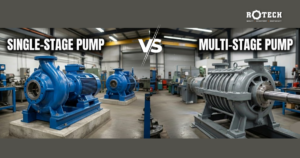
Single-Stage vs Multi-Stage Centrifugal Pumps: Key Differences
Choosing the right pump for
Horizontal vs. Vertical Centrifugal Pumps: Which One to Choose?
Centrifugal pumps are the workhorses

Rotech Pumps USA – New Address and Updates!
Dear Valued Customers, Partners, and