
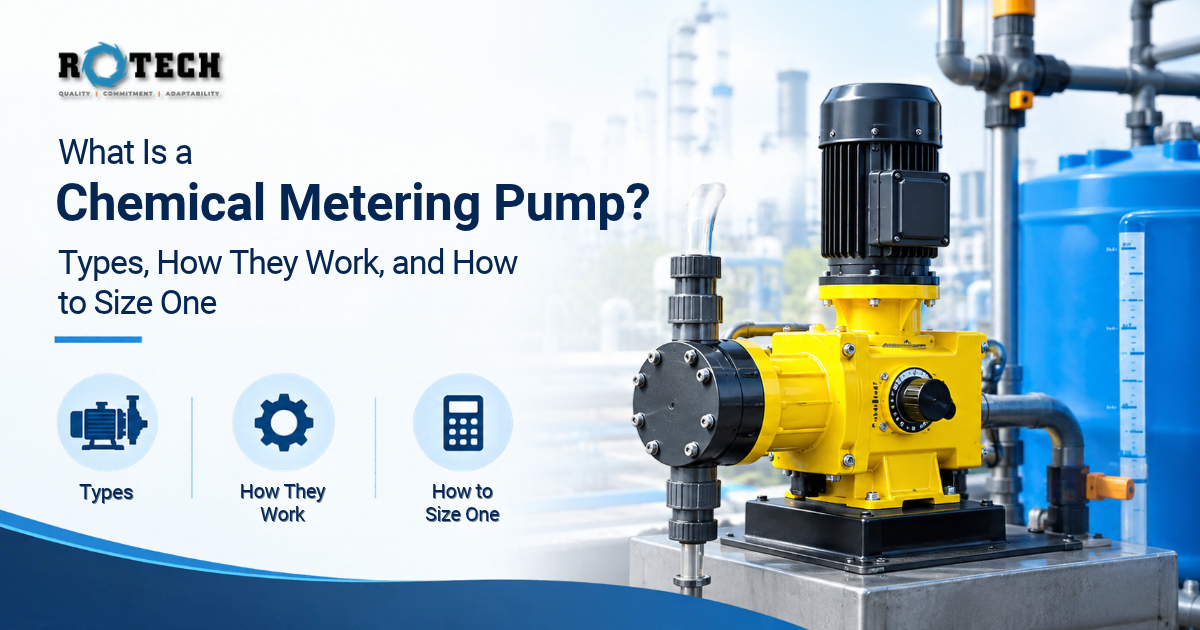
A chemical metering pump is a positive displacement pump that delivers a precise, controlled volume of chemical per stroke or revolution, regardless of system pressure. It is the right choice when accuracy matters more than volume — for dosing chlorine into a water main, adding a catalyst at a set ratio, or injecting a corrosion inhibitor into a pipeline.
Most pumps move as much fluid as the system will take. A metering pump moves exactly as much as you tell it to.
That one distinction is what separates chemical metering pumps from every other pump type, and it is why they are the default choice in any application where adding too much or too little of a chemical has real consequences — a process going off-ratio, a water treatment system under- or over-chlorinating, a pipeline corrosion inhibitor injected at the wrong concentration.
This guide explains how chemical metering pumps work, the main types available, the terminology that causes most of the confusion in this product category, and how to size one for your application.
What Makes a Pump a “Metering” Pump?
Two things define a metering pump:
1. Positive displacement operation. Unlike a centrifugal pump, which varies its output with changes in system pressure, a metering pump physically traps and displaces a fixed volume of fluid per stroke or revolution. That volume stays consistent whether your system pressure is 10 PSI or 150 PSI, which is what gives it the accuracy a centrifugal pump cannot provide. Our post on centrifugal vs. positive displacement pumps for chemical service explains this difference in full if you need background before the type-specific sections below.
2. Adjustable output. A metering pump’s output is controllable — by stroke length, stroke frequency, or both — so you can set a specific dose rate and hold it. This adjustability is what makes the pump genuinely useful for chemical dosing rather than just accurate once at a fixed setting.
Every metering pump combines these two characteristics. The different pump types within this category — diaphragm, piston, peristaltic, gear — all deliver controlled, repeatable displacement. They differ in how they achieve it, what chemicals they handle best, and how they perform under different pressure and flow conditions.
The Terminology Problem: Metering, Dosing, Feed, and Injection Pumps
These four terms cause more confusion in chemical pump selection than almost anything else. Engineers, distributors, and manufacturers all use them differently. Here is what they actually mean:
| Term | What It Usually Means | Overlap |
|---|---|---|
| Metering pump | A positive displacement pump with adjustable, controlled output — emphasises the measurement/accuracy angle | The broadest term — all dosing, feed, and injection pumps are metering pumps |
| Dosing pump | Same as metering pump — used more commonly in European and water treatment contexts | Interchangeable with metering pump in most contexts |
| Chemical feed pump | A metering pump used for continuous, proportional chemical addition — typically water treatment and industrial process applications | Subset of metering pumps, emphasises the continuous feed/addition function |
| Chemical injection pump | A metering pump that injects against significant backpressure — common in oil and gas, pipeline treatment, and pressurised reactor duty | Subset of metering pumps, emphasises the injection-against-pressure function |
For practical purposes: if someone asks for a metering pump, a dosing pump, a chemical feed pump, or a chemical injection pump, they are all asking for a positive displacement pump with controlled output. The differences come in the specific duty — flow rate, pressure, chemical, and whether the pump injects into a pressurised system or feeds into an open vessel.
Our dedicated guides on chemical feed pumps and chemical injection pumps cover each of those sub-categories in more depth. This post focuses on the metering pump concept and selection that underpins both.
How a Chemical Metering Pump Works
Most chemical metering pumps operate on a reciprocating principle — a displacement element moves back and forth to alternately draw chemical into a chamber on the suction stroke and push it out on the discharge stroke. Inlet and outlet check valves control the direction of flow through the pump head.
The volume displaced per stroke is fixed by the geometry of the pump chamber and the displacement element’s stroke length. The flow rate is determined by multiplying stroke volume by stroke frequency:
Flow rate = Stroke volume × Strokes per minute
To adjust output, you change one or both of these variables:
- Stroke length adjustment changes the volume per stroke — useful for coarse output setting.
- Stroke frequency adjustment changes the number of strokes per minute — used for fine control, including electronic control by a flow signal or process controller.
- Both combined gives the widest possible adjustment range, commonly described as the pump’s turndown ratio — the ratio of maximum to minimum reliable output (typically 10:1 to 100:1 depending on pump type and control method).
Types of Chemical Metering Pumps
Diaphragm Metering Pumps
A diaphragm metering pump uses a flexible diaphragm as the displacement element. The diaphragm flexes back and forth — driven either by a direct mechanical connection or by hydraulic pressure — to create the suction and discharge strokes. Because the diaphragm physically separates the process chemical from the pump’s drive mechanism, there is no sliding seal in contact with the chemical. This is the feature that makes diaphragm pumps the dominant choice for aggressive chemical metering.
Mechanical diaphragm pumps use a direct link between the motor eccentric and the diaphragm. They are cost-effective, reliable, and suitable for low-to-moderate pressures and flow rates. The diaphragm is a wear component — it needs periodic replacement, but the replacement cycle is predictable and the diaphragm itself is inexpensive.
Hydraulic diaphragm pumps drive the diaphragm with hydraulic oil rather than a direct mechanical connection. The hydraulic oil acts as a cushion, protecting the diaphragm from over-pressure and allowing more precise stroke control. They are the right step up for higher-pressure chemical injection service and for applications where very accurate dosing is required at high discharge pressures.
| Feature | Mechanical Diaphragm | Hydraulic Diaphragm |
|---|---|---|
| Pressure range | Low to moderate (typically up to 12 bar) | High (up to 100+ bar) |
| Dosing accuracy | Good | Excellent |
| Diaphragm protection | Limited — can be damaged by pressure spikes | Better — hydraulic oil cushions the diaphragm |
| Cost | Lower | Higher |
| Best for | General chemical dosing, water treatment | High-pressure injection, precise process duty |
Piston / Plunger Metering Pumps
A piston or plunger metering pump uses a reciprocating piston in direct contact with the process fluid. The piston displaces a precise volume on every forward stroke. Because the displacement mechanism is in direct contact with the chemical, wetted material selection is critical — the piston, cylinder, and all seal materials must be compatible with the chemical being metered.
Piston metering pumps offer very high pressure capability and excellent repeatability, which is why they are the standard for high-pressure chemical injection in oil and gas applications — injection into wellheads, pipelines, and separators at hundreds of PSI of backpressure.
The trade-off is wear. The piston seal and cylinder bore are in sliding contact with the process fluid, so abrasive or crystallising chemicals will cause premature wear. For aggressive or abrasive chemicals, a diaphragm design is usually the more practical choice.
Peristaltic Metering Pumps
A peristaltic metering pump moves fluid by compressing a flexible tube or hose with rotating rollers. The roller squeezes the tube, pushing fluid forward. As the roller passes, the tube springs back to its natural shape and draws in the next portion of fluid. There are no check valves in a peristaltic pump — flow direction is determined entirely by the direction of roller rotation.
The key characteristic of a peristaltic design is that the fluid only contacts the tube. There are no seals, no diaphragms, no internal chambers that the chemical touches — just the inside of the tube. This makes peristaltic pumps the right choice for:
- Very aggressive or corrosive chemicals where even a diaphragm introduces too many material contact points
- Shear-sensitive chemicals that would be damaged by piston or diaphragm mechanisms
- Applications where the pump must be completely self-contained with no external leak paths
- Low to moderate flow at moderate pressures
The tube is the only consumable in a peristaltic pump, and selecting the right tube material for chemical compatibility is the primary selection decision. PTFE and silicone tubes cover most industrial chemical applications.
Gear Metering Pumps
Gear pumps are rotary positive displacement pumps — two meshing gears trap fluid between their teeth and the casing wall and carry it from inlet to outlet. Unlike reciprocating metering pumps, gear pumps produce near-continuous flow with very low pulsation.
Gear pumps are not typically the first choice for precision low-flow dosing because their output depends more on backpressure than a reciprocating design’s does. However, for moderate viscosity chemicals where continuous, smooth flow is more important than extreme precision at very low flow rates — polymer dosing, lubricant metering, viscous additive addition — a gear pump is often the more practical option. Browse Rotech’s gear pump range for this duty.
Metering Pump vs. Chemical Feed Pump vs. Chemical Injection Pump: The Practical Difference
The three main sub-categories of metering pump in Rotech’s range serve distinctly different duties, even though the underlying pump technology overlaps:
Chemical feed pumps add a chemical continuously and proportionally to a process stream — chlorine into a water treatment plant, pH adjustment chemicals into a process line, scale inhibitor into a cooling tower. The flow rate is typically low, the pressure moderate, and the accuracy requirement is usually expressed as a percentage of the dose rate (e.g., within ±2%). See our chemical feed pump guide for selection detail and the chemical feed pump category.
Chemical injection pumps inject a chemical into a pressurised system — a pipeline at operating pressure, a pressurised reactor, a wellhead. The defining characteristic is high discharge pressure. The pump must inject against whatever pressure is in the system, which means the pump’s pressure rating must exceed the system pressure, often significantly. See our chemical injection pump guide and the chemical injection pump category.
General metering pumps cover applications that don’t fit neatly into either of the above — batch chemical addition, reagent dosing in laboratory and pilot plant settings, proportional chemical addition in processes that don’t run continuously.
How to Size a Chemical Metering Pump
Getting the size right matters more for a metering pump than for almost any other pump type. An oversized centrifugal pump can be throttled back. An oversized metering pump running at its minimum stroke frequency or minimum stroke length is operating in a region where accuracy is reduced and output becomes less predictable. Always size for maximum conditions, but confirm minimum output is within the pump’s reliable operating range.
Step 1: Determine Maximum Required Flow Rate
Calculate the maximum chemical dose rate your process requires. For water treatment applications, this is typically expressed in litres per hour or gallons per day based on the maximum flow through the system and the required chemical concentration. For process chemical addition, it comes from the process mass balance.
Size the pump to deliver 80–90% of its maximum rated output at your required maximum flow. This leaves headroom for calibration adjustment while keeping the pump out of the inaccurate low-stroke range.
Step 2: Determine Maximum System Discharge Pressure
For open-vessel addition (no backpressure), the pump only needs to overcome the weight of the chemical column in the suction line and discharge piping. For injection into a pressurised system, the pump’s rated pressure must exceed the system pressure at the injection point — add a safety margin of at least 10–15% above maximum anticipated system pressure.
Step 3: Confirm Chemical Compatibility
Identify every wetted surface the chemical will contact: pump head, diaphragm or piston, check valves, valve seats, o-rings, and all tubing and fittings. All must be compatible with the chemical, concentration, and temperature. For detailed guidance, see our chemical pump material compatibility guide.
Step 4: Confirm the Turndown Ratio
Your required flow range — from minimum to maximum dose rate — must fit within the pump’s reliable turndown ratio. A pump with a 10:1 turndown ratio can reliably deliver from 10% to 100% of its rated output. If your process requires wider variation than the pump’s turndown allows, electronic stroke frequency control or a different pump size is the solution.
Step 5: Consider Pulsation Dampening
Reciprocating metering pumps produce pulsed flow. At low stroke frequencies, the pause between pulses is long enough that downstream flow measurement instrumentation and control systems can see intermittent zero-flow readings, which can cause control loop instability. A pulsation dampener on the discharge line smooths the flow signal and is standard practice on metering pump installations connected to flow-controlled processes.
Applications of Chemical Metering Pumps
| Application | Chemical Typically Dosed | Why Metering Is Required |
|---|---|---|
| Drinking water and wastewater treatment | Chlorine, sodium hypochlorite, fluoride, coagulant | Regulatory dose limits — too little leaves pathogens, too much creates disinfection byproducts |
| Cooling tower water treatment | Scale inhibitor, biocide, pH adjuster | Precise proportional control to system flow prevents scale and biological fouling |
| Oil and gas pipeline treatment | Corrosion inhibitor, scale inhibitor, biocide | Injection against line pressure with precise ratio to line flow rate |
| Boiler water treatment | Oxygen scavenger, corrosion inhibitor, pH control chemical | Continuous proportional dosing to feedwater flow — underdosing causes corrosion |
| Swimming pool and aquatic facilities | Chlorine, pH adjuster | Tight concentration bands for bather safety and equipment life |
| Chemical manufacturing | Catalyst, reagent, acid/base for pH control | Exact stoichiometric ratios determine product quality and yield |
| Food and beverage processing | Sanitiser, pH adjuster, flavour additive | Food safety and consistency requirements demand precision |
| Pharmaceutical manufacturing | Reagents, pH control chemicals | GMP accuracy requirements for API concentration and process control |
Maintaining a Chemical Metering Pump
Metering pumps are simpler in design than large centrifugal process pumps, but their check valves and diaphragms are consumable components with defined service intervals — and when they wear, dosing accuracy drifts before a visible failure occurs.
Calibration checks are the most important routine task on a metering pump. Use a calibration cylinder to physically measure the actual output volume over a timed period and compare it against the pump’s set point. Do this at commissioning and then on a regular schedule — monthly is standard for water treatment applications. Any significant deviation means a worn check valve, a fatigued diaphragm, or air in the suction line.
Check valve inspection should happen whenever calibration shows drift. The inlet and outlet check valves are the components most likely to cause accuracy loss — a check valve that does not seat fully allows backflow between strokes, which reduces the net dose per stroke.
Diaphragm replacement on mechanical diaphragm pumps follows the manufacturer’s schedule, typically one to three years depending on chemical severity and duty cycle. Do not wait for a visible diaphragm failure — a failing diaphragm allows process chemical to migrate toward the drive mechanism, which causes secondary damage far more expensive than the diaphragm itself.
For the full preventive maintenance framework for chemical pumps, see our chemical pump maintenance guide. For diagnosing performance problems on an in-service metering pump, our chemical pump troubleshooting guide covers the most common failure modes and their diagnostic approach.
Chemical Metering Pump Safety
The U.S. Environmental Protection Agency includes chemical feed and metering systems within its Risk Management Program requirements for facilities handling hazardous chemicals above threshold quantities. Documented inspection and maintenance records for chemical metering pumps are part of the mechanical integrity program requirements under OSHA 29 CFR 1910.119 for facilities where metered chemicals meet the process safety management threshold.
Practically, chemical metering pump safety means:
- Secondary containment around the pump and day tank for any chemical that would cause harm if released
- Pressure relief on the discharge line — a blocked discharge on a positive displacement pump builds pressure until something fails
- Correct chemical compatibility on every wetted component, including the tubing and fittings, not just the pump head
- Suction lines filled and free of air before start — a metering pump running against a vapour lock may appear to be operating normally while delivering no chemical
For practical guidance on safe transfer of corrosive chemicals, see our post on how to transfer corrosive chemicals safely using centrifugal pumps — the chemical handling principles apply equally to metering pump installations.
Frequently Asked Questions
What is a chemical metering pump? A chemical metering pump is a positive displacement pump that delivers a precise, adjustable, and repeatable volume of chemical per stroke or revolution, regardless of system pressure. It is used wherever chemical addition must be accurate — water treatment dosing, process chemical injection, corrosion inhibitor addition, and pH control.
What is the difference between a metering pump and a dosing pump? The two terms are interchangeable. Metering pump is more common in North American and process industry contexts. Dosing pump is more common in European and water treatment contexts. Both describe a positive displacement pump with adjustable, controlled output.
What is the difference between a chemical feed pump and a chemical metering pump? A chemical feed pump is a type of metering pump used for continuous, proportional chemical addition — typically to a flowing water or process stream. All chemical feed pumps are metering pumps. Not all metering pumps are chemical feed pumps — some are batch dosing, injection, or reagent addition designs.
How do you size a chemical metering pump? Size for maximum required flow rate at 80–90% of the pump’s rated maximum output. Confirm the pressure rating exceeds maximum system discharge pressure with a 10–15% safety margin. Verify chemical compatibility of all wetted parts. Confirm your required flow range fits within the pump’s reliable turndown ratio. Add a pulsation dampener for flow-controlled processes.
What is turndown ratio in a metering pump? Turndown ratio is the ratio of maximum reliable output to minimum reliable output. A pump with a 10:1 turndown ratio can accurately dose from 10% to 100% of its rated capacity. Outside the reliable range, dosing accuracy falls. Electronic stroke frequency control extends the effective turndown range.
Which type of metering pump is best for corrosive chemicals? Diaphragm metering pumps — either mechanical or hydraulic — are the standard choice for corrosive chemical dosing because the diaphragm isolates the drive mechanism from the process chemical. For the most aggressive chemicals, a PTFE-lined hydraulic diaphragm design with PTFE check valve components provides the widest chemical resistance. The specific pump head material must be confirmed against the chemical, its concentration, and temperature.
Does a chemical metering pump need a pulsation dampener? Not always, but it is good practice for flow-controlled processes. Reciprocating metering pumps produce pulsed flow — one surge per stroke — which can cause instability in flow measurement and control instruments downstream. A pulsation dampener on the discharge line smooths the flow profile and is standard on metering pump installations connected to closed-loop process controls.
Can a metering pump inject against high backpressure? Yes — this is one of the principal advantages of positive displacement design. A metering pump’s output stays consistent as discharge pressure rises, unlike a centrifugal pump whose output collapses. For high-pressure injection into pipelines, reactors, or wellheads, a hydraulic diaphragm or piston metering pump rated to exceed system pressure is the correct choice.
Summary
A chemical metering pump does one thing that no other pump type can do reliably: it delivers a precise, controllable, repeatable volume of chemical per unit time, regardless of what pressure is on the other side of the discharge. That characteristic makes it the correct choice for any application where accuracy matters — water treatment dosing, process reagent addition, pipeline injection, pH control, and ratio-critical chemical addition.
The choice between diaphragm, piston, peristaltic, and gear designs comes down to four variables: the chemical and its compatibility requirements, the discharge pressure, the required flow rate and turndown range, and the acceptable maintenance complexity.
At Rotech Pumps, our chemical feed pump range and chemical injection pump range cover the most common metering pump duties across water treatment, chemical processing, and oil and gas service across the USA and Canada. If you need help selecting the right metering pump for your chemical and duty conditions, submit a pump inquiry or contact our engineering team with your chemical, flow rate, and system pressure — we will confirm the right design and configuration for your application.
Recent Posts
What Is a Chemical Metering Pump? Types, How They Work, and How to Size One
A chemical metering pump is
Centrifugal Pump Installation Guide: Step-by-Step Best Practices
A centrifugal pump installation has
Chemical Compatibility Guide: Pump Materials for Common Industrial Chemicals
Picking the wrong pump material