
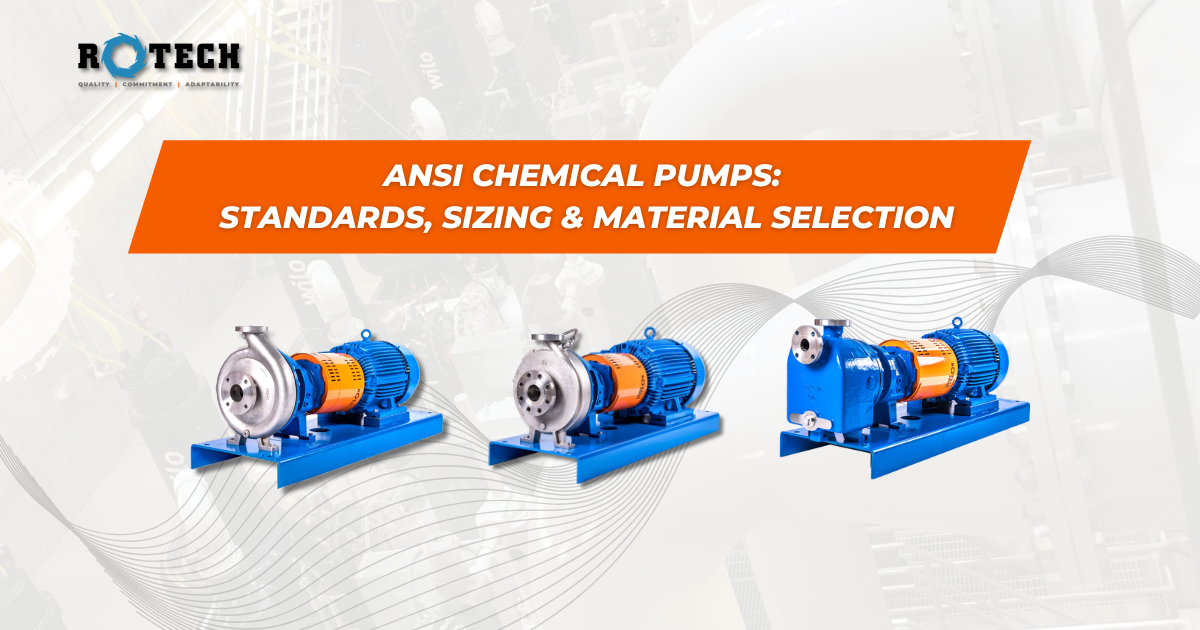
ANSI chemical pumps are centrifugal pumps built to the ASME B73.1 dimensional standard, which guarantees that a pump from one manufacturer can be swapped for a pump from another without changing the baseplate, piping, motor mount, or coupling. That interchangeability, not the pump’s internal design, is what “ANSI” actually refers to, and it’s the main reason ANSI pumps are the default choice for chemical processing, refining, and pulp and paper plants across North America.
This guide covers what makes an ANSI pump suitable for chemical service specifically, how the size groups and material options work, and how to choose between Rotech’s sealed and configuration options. For the broader explanation of the ANSI standard itself, see our complete guide to ANSI pumps.
What Makes a Pump “ANSI”?
The term ANSI is a bit of a misnomer carried over from industry convention, the actual standard, ASME B73.1, is published by the American Society of Mechanical Engineers, not ANSI itself. What matters practically is that every ANSI pump of a given size, regardless of manufacturer, shares identical envelope dimensions, so a plant can replace a failed pump from a different brand without re-engineering the installation. A related standard, ASME B73.3, covers sealless (magnetic-drive) ANSI pumps for applications where zero leakage is non-negotiable.
ANSI Pump Size Groups
ANSI pumps are organized into three dimensional groups, and knowing which group your application falls into narrows your material and configuration options considerably:
Group | Typical Size Range | Common Use Case |
|---|---|---|
Group I | 1.5×1-6 to 3×1.5-8 | Lower flow, lower horsepower chemical transfer and metering-adjacent duty |
Group II | 3×2-8 to 6×4-13 | The most common group for general chemical process transfer |
Group III | 6×4-16 to 10×8-17 | High-flow bulk chemical transfer |
Rotech’s 1196 Series and 1296 Series cover frame-mounted and close-coupled configurations across these groups, while the 1196LF and 1296LF Low Flow Series are purpose-built for chemical applications where flow needs to stay low and steady rather than high-volume.
Choosing the Right Material for Chemical Service
Material selection is where ANSI chemical pumps diverge most from general-purpose ANSI pumps used on water or mild fluids. The right choice depends on the specific chemical, its concentration, and its temperature:
Material | Typical Chemical Service | Notes |
|---|---|---|
316 Stainless Steel | General acids and chemicals at moderate concentration | The default starting point for most chemical ANSI pumps |
CD4MCu (Duplex Stainless) | Sulfuric and phosphoric acid, chloride-bearing fluids | Stronger chloride resistance than standard 316SS |
Alloy 20 | Sulfuric acid across a range of concentrations | See our sulfuric acid material comparison for concentration/temperature specifics |
Hastelloy | Highly corrosive, oxidizing, or chloride-heavy chemicals | Premium option for the most aggressive services |
PTFE/PFA-lined | Aggressive acids where metallic wetted parts aren’t viable | Often paired with sealless designs |
For acid-specific selection, including how concentration and temperature shift the right material choice, see our acid pumps guide.
Frame-Mounted vs. Close-Coupled ANSI Chemical Pumps
ANSI chemical pumps come in two basic configurations, and the choice affects maintenance, footprint, and cost:
- Frame-mounted pumps use a separate bearing frame connecting the pump to its own bearings, coupled to the motor. This makes the pump and motor independently serviceable, you can pull the pump for seal or impeller work without disturbing the motor. Rotech’s 1196 Series is built on this configuration, generally preferred for larger or higher-horsepower chemical applications where serviceability matters more than footprint.
- Close-coupled pumps mount the impeller directly on an extended motor shaft, eliminating the separate bearing frame and coupling entirely. This reduces footprint, alignment work, and parts count, at the tradeoff of motor and pump no longer being independently serviceable. Rotech’s 1296 Series and 1796 Series cover this configuration.
Most chemical plants standardize on one configuration across a process area to simplify spare parts and maintenance training, so it’s worth deciding this early rather than mixing configurations pump-by-pump.
Industries That Rely on ANSI Chemical Pumps
- Chemical processing and petrochemical, the largest single user base for ANSI pumps, given the standard’s emphasis on corrosion-resistant materials and interchangeability.
- Oil and gas refining, for transfer duty that doesn’t require the heavier-duty API 610 standard.
- Water and wastewater treatment, chemical dosing and transfer of treatment chemicals.
- Pulp and paper, handling process chemicals and bleaching agents.
- Pharmaceutical and food processing, lower-corrosivity chemical handling where ANSI’s material flexibility still applies, even though hygienic design standards layer on top.
Sealed vs. Sealless ANSI Chemical Pumps
- Mechanically sealed (B73.1): uses a rotating mechanical seal around the shaft. Lower upfront cost, easier to service, and the right choice for the vast majority of chemical applications. Browse Rotech’s mechanical seal range to match a seal to your chemical and pressure conditions.
- Sealless / magnetic-drive (B73.3): eliminates the rotating seal entirely by driving the impeller magnetically through a containment shell, removing the leak path completely. This is worth the added cost for highly toxic, flammable, or environmentally regulated chemicals where any leakage is unacceptable, but it comes with flow and pressure limitations a standard sealed pump doesn’t have.
How to Choose an ANSI Pump for Your Chemical Application
- Identify the chemical, concentration, and temperature first, this determines which materials are even on the table before you think about size.
- Calculate your required flow rate and head. Our centrifugal pump flow rate guide covers how to translate process requirements into a pump curve.
- Pick the size group that comfortably covers your flow/head requirement without running far off the pump’s best efficiency point.
- Decide sealed vs. sealless based on toxicity, flammability, and your facility’s tolerance for any leakage risk.
- Select the seal if going the mechanically sealed route, see our chemical pump materials and seal section for how that decision interacts with material choice.
- Confirm interchangeability with your existing baseplate and piping if you’re replacing an existing ANSI pump from another manufacturer, this is the entire point of the ANSI standard, so use it.
Frequently Asked Questions
Are ANSI pumps good for chemical applications? Yes, ANSI (ASME B73.1) pumps are the most widely used centrifugal pump standard for chemical processing in North America, largely because of dimensional interchangeability across manufacturers and the wide range of corrosion-resistant materials available.
What’s the difference between ANSI and API pumps? ANSI pumps follow ASME B73.1 and are built for general chemical and industrial process service; API pumps follow API 610 and are built for the more demanding pressure, temperature, and reliability requirements of oil and gas refining. See our full ANSI vs. API comparison.
What material should I choose for an ANSI chemical pump? It depends entirely on the chemical, its concentration, and temperature, 316 stainless steel covers most general chemical service, while Alloy 20 and Hastelloy are reserved for more aggressive acids and oxidizers.
Can ANSI pumps be sealless? Yes, ASME B73.3 covers magnetic-drive, sealless ANSI pumps, used when zero leakage is required for toxic, flammable, or strictly regulated chemicals.
Can I replace a competitor’s ANSI pump with a Rotech ANSI pump without re-piping? That’s the entire purpose of the ANSI standard, any compliant ANSI pump of the matching size group should share baseplate, motor mount, and piping dimensions with your existing installation. Confirm the specific size designation against your current pump before ordering.
Frame-mounted or close-coupled, which should I choose for a new chemical installation? Frame-mounted if you expect to service the pump frequently or need higher horsepower; close-coupled if footprint and lower parts count matter more and the application is lower-horsepower. See the comparison above for the tradeoffs.
Need help specifying the right ANSI pump for your chemical application? Talk to Rotech’s engineering team or browse the full ANSI pump range.
Recent Posts

Centrifugal Pump Installation Guide: Step-by-Step Best Practices
A centrifugal pump installation has
Chemical Compatibility Guide: Pump Materials for Common Industrial Chemicals
Picking the wrong pump material
Chemical Pump Troubleshooting: Diagnosing Common Failures
Chemical pumps work hard. They